
SOAR
This research focused on how to support air traffic controllers in safely and efficiently managing arriving and departing aircraft that are flying in shared airspace.
In metroplex environments, efficiency and delays can be further compromised by the density and complexity of operations. A metroplex is defined by the Joint Planning and Development Office (JPDO) as an area with high traffic demand served by two or more airports with arrival and departure operations that are highly interdependent. Metroplex interdependencies stem from different traffic flows sharing common fixes, paths or airspace volumes within the metroplex airspace.
Terminal area flows often compete for the same airspace resources. Today, high-priority flows are given efficient procedures through the airspace, while lower-priority flows are given less efficient procedures in the remaining airspace. Examples are when departure flows tunnel under arrival streams or when a major airport arrival stream forces satellite airport arrivals or departures to fly extra distance to avoid using the same airspace. These are examples of spatial or procedural separation. The other common means of separating aircraft is with temporal separation. First, one aircraft uses the airspace, and then another. Temporal separation is currently used to separate aircraft where flows merge at arrival meter fixes or runways. Scheduling can be used to make temporal separation more efficient. Schedulers for arrival traffic like the Traffic Management Advisor (TMA) are based on predictions of when aircraft in multiple flows will reach merge points.
Several studies on operations in metroplex environments have explored trajectory-based scheduling and temporal separation to applications where flows of arriving and departing aircraft from multiple airports cross each other. Optimization problems indicate that being able to dynamically use either or both spatial or temporal separation results in the most efficient operations.
The objective of this project was to explore operational issues of managing metroplex operations with either spatially or temporally shared terminal airspace resources such as, route segments, fixes and runways. Our approach was to pick a potential shared airspace problem where spatial separation is currently used and to develop a new operational concept where either spatial or temporal separation was used and then evaluate the procedures and controller tools in a Human-In-The-Loop simulation.
Our operational concept was based on the use of advanced scheduling and spacing tools to identify and display gaps in an arrival flow that could be used by aircraft on an optimized departure route that crosses the arrival flow. The airport tower has a timeline schedule that shows when departing aircraft on the optimized route should depart in order to cross gaps in the arrival flow (see picture of timeline below). The departure route is also designed to fly on a procedural route that is vertically separated from arrival aircraft in the off-nominal case where lateral separation with the arrival aircraft was not adequate. Terminal Radar Approach Control controllers use point-out or pre-arranged coordination procedures to coordinate the departures to climb through arrival airspace.
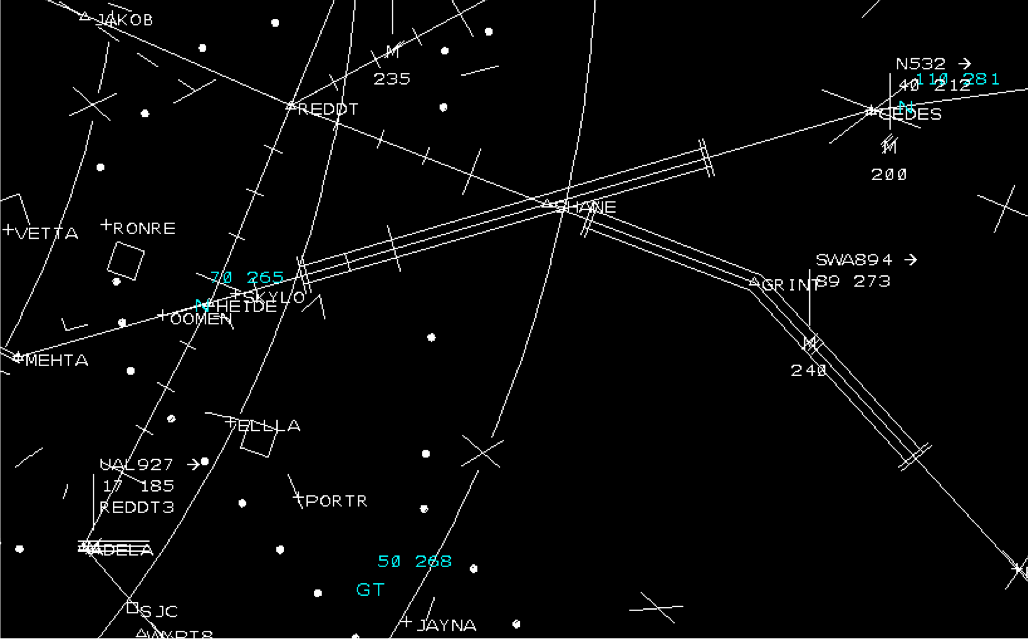
Decision support tools were explored to improve the safety of the controllers’ decision to climb departure aircraft through arrival airspace. We are looking into using depiction of arrival and departure aircraft’s positions on timeline and on the radar scope. We were interested in using static or dynamic tools to predicting conflicts between arrival and departure aircraft. We were also interested in developing a tool that resolved departure trajectories that were conflicting and suggested new trajectories that can be used to safely cross arrival traffic. Examples of tools were: tie-box markings, conflict probe, ghosting position, slot markers, and trajectory resolution and scheduling.
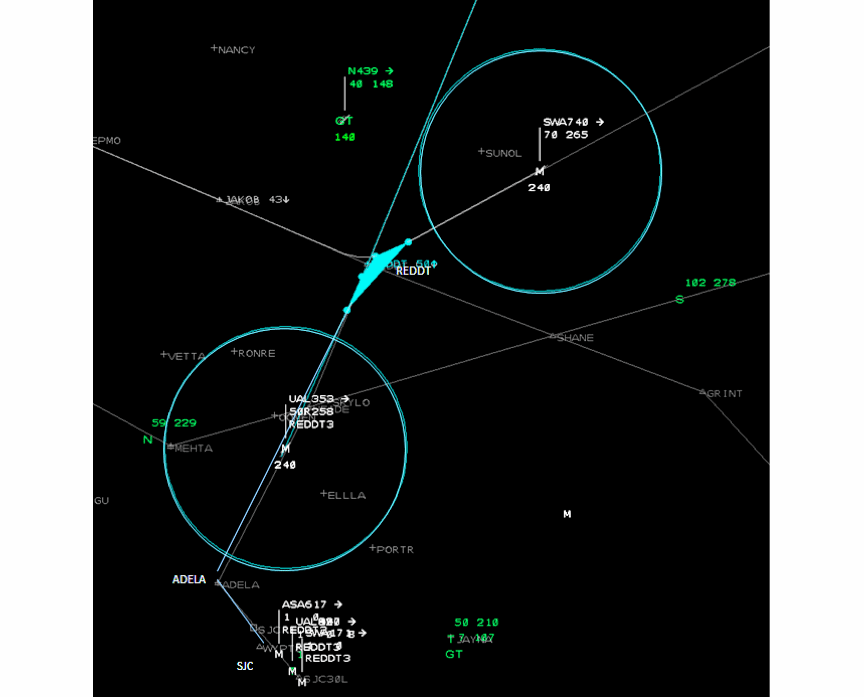
Underneath is an example of tie-boxes. Tie boxes are static tools used to predict the loss of separation of two aircraft flying to a same waypoint. It uses a reference point for one aircraft and checks the relative positions of other aircraft. If some other aircraft are inside a tie-box, it means that the relative aircraft will likely be less than 4 miles away from the referenced aircraft when it crosses the shared waypoint.
Another example is a conflict probing tool. The tool is a dynamic tool that predicts whether a loss of separation for a given aircraft can be anticipated with other surrounding aircraft. It computes the trajectories and predicts the separation for converging trajectories. The tool can be set to be an alert or can be set to be used at the controller’s discretion.
Other shared airspace configurations were also explored. For instance, scheduling and merging departure aircraft from two airports that go over the same waypoint.
The post SOAR appeared first on NASA Science.