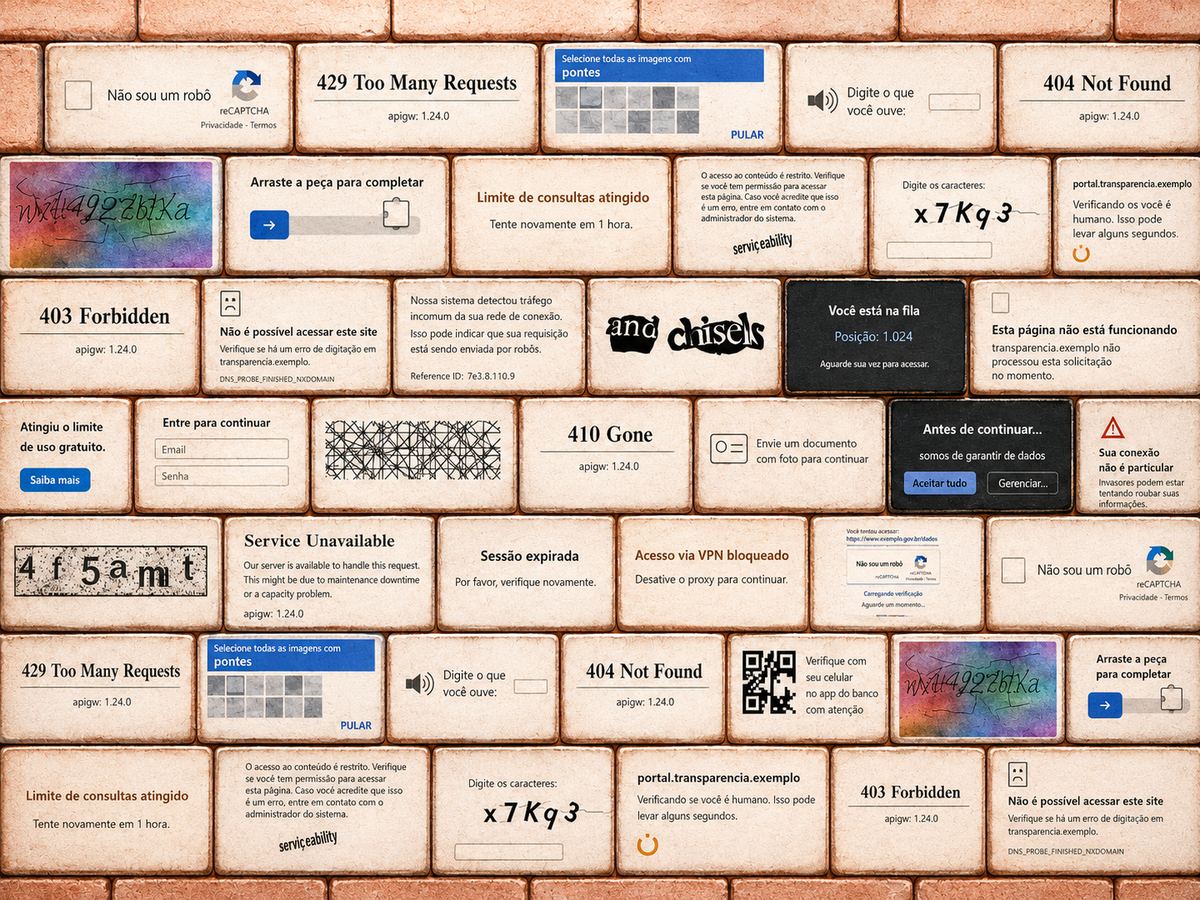
Opinion piece — this text takes a position from the title onward. It argues, first, that keeping RSS (Really Simple Syndication — an open protocol for distributing content over the internet) feeds alive and open is, today, an act of public oversight of power, as consequential as any principle of open justice. It argues, second, that electronic barriers conceived to protect private data, when turned against public data, threaten precisely the tool — artificial intelligence within reach of the ordinary citizen — that could most democratize accountability. This is not a neutral report.
There is a technology from 1999 that quietly continues to sustain part of the journalism still circulating independently of anyone else's platform: RSS. It was born as a convenience — gathering the headlines of many sites in one place — and became, without anyone having planned it, a modest piece of democratic infrastructure, built over more than two decades by a small number of people whose work deserves to be remembered. This article grows out of concrete stumbles we had while building this site on that foundation: feeds that misdeclared their own language, official sources shielded behind anti-robot walls, and the repeated finding that openness, in practice, is a matter of continuous upkeep, not a natural state of things.
What RSS is and why it matters
RSS is a simple format: a text file that lists, in a standardized way, what has changed on a site. There is no company that owns the protocol; no charge for access; no engagement metric to maximize. Anyone — or any program — can subscribe to the file and know when a source has published something new, without depending on the relevance judgment of someone else's algorithm — the opposite of the model of the major social networks, which decide, behind an opaque algorithm, what each person sees.
Seen from the inside, a feed is simply this — a handful of tags around each headline:
<channel>
<title>Site name</title>
<item>
<title>Story headline</title>
<link>https://example.org/story</link>
<pubDate>Thu, 02 Jul 2026 12:00:00 GMT</pubDate>
</item>
</channel>
There is nothing else behind it: no tracker, no reader profile, no "engagement" metric. A twenty-line program reads this; a person, with a minimum of habit, can too.
Technically the format had two lineages that competed for space in the early 2000s. One was RSS 1.0, based on RDF (Resource Description Framework — the web's data description model), whose technical drafting included a fourteen-year-old contributor named Aaron Swartz. The other was RSS 0.91/2.0, consolidated by the American programmer Dave Winer, which would prevail as the more widely adopted standard. On 11 January 2001, Winer demonstrated for the first time the feature that decades later would be called podcasting: he attached a Grateful Dead song to a post on his blog, Scripting News, on the air since 1997, and delivered the audio file through the feed itself. CRIDLAND, James. The Story of the First Podcast Feed. Podnews. Available at: https://podnews.net/article/first-podcast-feed-history. Accessed: 2 July 2026. (on Dave Winer, at the end of the article)
Aaron Swartz, the teenager behind RSS 1.0, would years later use the same technical fluency to try to free millions of American court records held behind a paywall (PACER — Public Access to Court Electronic Records, the paid access system for United States federal court proceedings). On his life and his death, we refer to the profile written by the journalist Larissa MacFarquhar in The New Yorker a few weeks later — a long, careful text, deliberately skeptical toward both extremes of the narrative that formed around him, a benchmark for handling the subject with the sobriety it deserves. MACFARQUHAR, Larissa. Requiem for a Dream. The New Yorker, 3 March 2013. Accessible copy hosted by Duke University. Available at: https://courses.cs.duke.edu/compsci342/spring20/netid/readings/newyorker-swartz.pdf. Accessed: 2 July 2026. (on Aaron Swartz, at the end of the article)

RSS as a Tool of Public Oversight
Swartz's case is not an isolated episode. Decades earlier, the American engineer Carl Malamud was already testing the same thesis: in 1994, he published for free on the internet the records of the SEC (Securities and Exchange Commission — the American financial-market regulator), until then only accessible through a paid service. The gesture led the agency itself to put them online, free of charge, two years later. CIVIC TECH FIELD GUIDE. Carl Malamud Launches Free Online Access to SEC EDGAR Records. Available at: https://civictech.guide/listing/carl-malamud-launches-free-online-access-to-sec-edgar-records/. Accessed: 2 July 2026. In 2020, the same Malamud obtained from the United States Supreme Court the recognition that the State of Georgia could not hold copyright over its own annotated legal code — reaffirming, in court, a principle this site also seeks to follow: those who speak with the force of law are not, for copyright purposes, the authors of what they produce in that capacity. UNITED STATES. Supreme Court. Georgia v. Public.Resource.Org, Inc., no. 18-1150, decided 27 April 2020. Available at: https://www.supremecourt.gov/opinions/19pdf/18-1150_7m58.pdf. Accessed: 2 July 2026. (on Carl Malamud, at the end of the article)
The relationship between RSS and the press has also been the subject of sober analysis, not only of technical enthusiasm. When Google shut down Google Reader in 2013, the journalist Mark Coddington devoted one of his weekly reviews at the Nieman Journalism Lab — the research center on the future of journalism affiliated with Harvard University — to examining what that closure revealed about the news industry's dependence on third-party platforms. CODDINGTON, Mark. This Week in Review: The lessons of Google Reader's death, and the free labor of news sources. Nieman Journalism Lab, 15 March 2013. Available at: https://www.niemanlab.org/2013/03/this-week-in-review-the-lessons-of-google-readers-death-and-the-free-labor-of-news-sources/. Accessed: 2 July 2026. Today, the institutional version of the same default-openness principle is found in portals like the American GovInfo, which publishes official RSS feeds from Congress and federal agencies. GOVINFO. RSS Feeds. Available at: https://www.govinfo.gov/feeds. Accessed: 2 July 2026. This is the literal sense of open justice: to make public, by default, without the citizen having to request it — the same standard fixed by the Council of Europe's Tromsø Convention, the first binding international instrument to recognize the right of all, without discrimination, to access official documents. COUNCIL OF EUROPE. Tromsø Convention, CETS no. 205, 2009. Available at: https://www.coe.int/en/web/access-to-official-documents. Accessed: 2 July 2026.
Judicial Secrecy, When It Ceases to Be an Exception
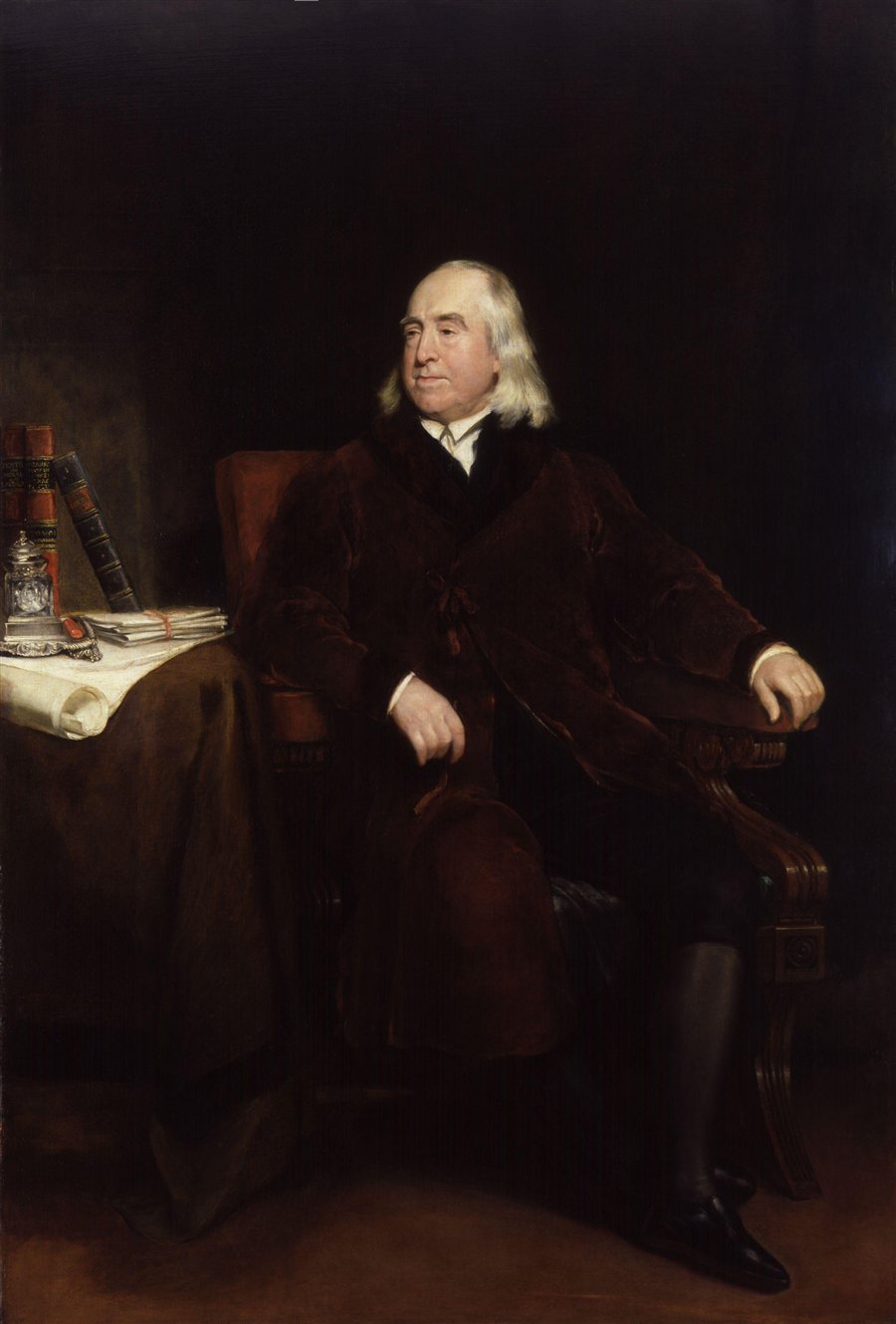
The same reasoning applies to the courts. The English philosopher Jeremy Bentham, in a century when the idea was still seen as radical, wrote that publicity is the very soul of justice: the keenest spur to exertion, the surest of safeguards against improbitas (dishonesty in the handling of public affairs) — and what keeps the judge, while judging, under judgment. BENTHAM, Jeremy. Draught of a Code for the Organization of the Judicial Establishment in France (1790). In: BOWRING, John (ed.). The Works of Jeremy Bentham. Edinburgh: William Tait, 1843. v. 4. Available at: https://oll.libertyfund.org/titles/bowring-the-works-of-jeremy-bentham-vol-4. Accessed: 2 July 2026. (on Jeremy Bentham, at the end of the article) The American jurist Louis Brandeis, a century later, would revisit the same argument in a now-classic essay on publicity as social remedy: sunlight, he wrote, is said to be the best of disinfectants, and electric light the most efficient policeman. BRANDEIS, Louis D. What Publicity Can Do. Harper's Weekly, 20 December 1913. Reprinted in: Other People's Money and How the Bankers Use It. New York: Frederick A. Stokes, 1914. ch. V. Full text hosted by the Louis D. Brandeis School of Law Library (University of Louisville). Available at: https://law.louisville.edu/lawlibrary/special-collections/louis-d-brandeis-collection/writings-louis-d-brandeis/other-peoples-money-3. Accessed: 2 July 2026. (on Louis Brandeis, at the end of the article)
But the right at issue here is not that of the party to the proceeding — it is that of the person on the outside. Whoever consults someone else's case is not being judged: they are judging. And it is for this figure — the third party, the citizen, the press — that international instruments reserve another guarantee: the freedom to seek and receive information. The International Covenant on Civil and Political Rights inscribes it in Article 19, and the United Nations Human Rights Committee, interpreting that article, derived from it a right of access to information held by public bodies, together with the state's duty to publish, on its own initiative, whatever is of public interest. UNITED NATIONS. Human Rights Committee. General Comment No. 34 — Article 19: Freedoms of opinion and expression (CCPR/C/GC/34), 2011. Available at: https://undocs.org/CCPR/C/GC/34. Accessed: 2 July 2026. The European Court of Human Rights reached the same conclusion through Article 10 of the European Convention on Human Rights: in the case Magyar Helsinki Bizottság v. Hungary, the Grand Chamber recognized that the refusal of state information may violate freedom of expression when access is instrumental to public debate and the requester exercises the function of a social "watchdog" — a role the Court itself was careful not to restrict to the press and non-governmental organizations, extending it to bloggers and users of social networks. EUROPEAN COURT OF HUMAN RIGHTS. Magyar Helsinki Bizottság v. Hungary, application no. 18030/11, Grand Chamber, 8 November 2016. Available at: https://hudoc.echr.coe.int/eng?i=001-167828. Accessed: 2 July 2026. Added to the Tromsø Convention, cited above, these guarantees describe exactly the reader this article is about: the person who is not a party, not a defendant, does not ask for a favor — but oversees. The problem, then, is not that Judicial Secrecy exists; narrow exceptions for victims, minors, and security are legitimate. The problem is that the exception ceases to be narrow and becomes an administrative habit. In different countries, one observes the same pattern: secrecy conceived to protect fragile victims ends up, in practice, shielding powerful defendants from scrutiny — and the yardstick that separates the two uses is impossible to police without public information about the very existence of the secrecy.
Quis custodiet ipsos custodes? — Who Watches the Watchers
Behind the scenes of this site, we encounter the same tension in smaller scale. Several official sources hide their content behind anti-robot verification systems — of the same family as Google's reCAPTCHA, conceived to separate humans from automated programs. In 2026, that system began to demand, in situations of what it considers suspicious traffic, QR-code verification (Quick Response — a two-dimensional barcode read by the phone's camera) that depends on device attestation. This feature only works with Google's services installed or the Apple equivalent; users of privacy-oriented systems, like GrapheneOS, lose access to the entire site. CYBERINSIDER. Google's new reCAPTCHA system restricts access to the open web. Available at: https://cyberinsider.com/googles-new-recaptcha-system-restricts-access-to-the-open-web/. Accessed: 2 July 2026; CYBERNEWS. Google's new QR-code reCAPTCHA locks out anyone without a vetted iPhone or Android. Available at: https://cybernews.com/privacy/google-qr-code-recaptcha-requires-approved-phone/. Accessed: 2 July 2026.
This directly touches a principle this site tries to follow: that of working on an old cell phone and an old smart TV. A security tool that excludes those who cannot afford the latest hardware is, in practice, a form of censorship by infrastructure — no one is forbidden from access; access is merely made impossible.
There is, however, a deeper layer to this exclusion — and it requires honest acknowledgment before the criticism. These barriers have, at their origin, a legitimate purpose: not all scraping is benign, and verification mechanisms were born to protect private systems and data against fraud, overload, and the mass collection of personal information. The problem begins when the same mechanism is transposed, without distinction, to public data — the data that, by definition, any citizen has the right to consult. Applying to a transparency portal the same lock devised to shield a private database is, at the very least, a misuse of power (the détournement de pouvoir of Administrative Law — the use of a power for a purpose other than the one that legitimates it): a tool created to guard the private is turned against the public.
And the effect, for anyone trying to keep watch, is always the same. Anyone who has ever tried to extract data from a transparency portal knows the routine: the captcha that reappears on every page, the query limit per hour, the document served only as an image, precisely so it cannot be read by machine. Against public data, these are obstacles that make most people give up before finding what they are looking for — an opacity that disguises itself as security and hollows out from within the transparency that governments owe regarding the spending of public money.
Now these same walls are also blocking artificial intelligence — and it is here that the loss becomes greater than it appears. Still in its infancy, AI already shows itself a powerful and, above all, accessible instrument: with it, a citizen without a team or a budget can sweep through thousands of pages and detect what dispersed human reading lets slip: the same supplier reappearing in the contracts of agencies that ought not to intersect, a publication date earlier than the tender it should follow, an identical amount in invoices that ought to be independent — the incongruity between what is declared and what is paid, the hypocrisy between the speech and the record. And to gather, from all this, the clues that help discover, and prove, what the law, since Rome, has learned to name: peculatus (the diversion of what is public to private benefit) and improbitas (dishonesty in the handling of public affairs), which international conventions today rewrite as corruption, grand corruption (high-level corruption, moving large sums and exercising high authority) and illicit enrichment (the unlawful enrichment of someone exercising a public function) — the common language fixed by the United Nations Convention against Corruption. UNITED NATIONS. United Nations Convention against Corruption (UNCAC), 2003. Available at: https://www.unodc.org/unodc/en/corruption/uncac.html. Accessed: 2 July 2026. We noticed it while building our own projects: tasks that once required months of manual work and a team few can afford now fit within the reach of a single person. A verification that presents itself as a defense against robots ends up, without saying so, defending opacity against the very tool that could most democratize accountability over power. The question that the Roman poet Juvenal posed nearly two thousand years ago — the one that gives this section its title — finally finds an answer within reach of the ordinary citizen.
The hardening is not a coincidence of the calendar. It was precisely when artificial intelligence reached the hand of the ordinary citizen — capable of scraping financial and forensic data scattered across the internet, cataloguing it, organizing it, and finding in it clues and even proof of corruption — that the barriers began to tighten with a haste one would call desperation. What once tolerated the human reader began to block even individual, single-item access: one piece of information, one case. Consulting anything at all has become tiresome and cumbersome — including what is private and personal, even the records of a party to a court case. Each day we come closer to the dystopia of 1984, where everything we do on the internet is watched — but we cannot access public accounts, administrative and judicial records, and so on. ORWELL, George. Nineteen Eighty-Four. London: Secker & Warburg, 1949. Available at: https://gutenberg.net.au/ebooks01/0100021h.html. Accessed: 3 July 2026.
What We Learned Building This Site
Everything said up to here — publicity as the soul of justice, the feed that no one owns, the security gate that turns into a wall — reached us by the most prosaic route there is: that of the people who keep a news site on the air. We are not speaking as philosophers of access to information, nor as legal scholars of open justice; we speak as the people who, in trying to gather in one place the voices of hundreds of sources, ran up against the concrete edges of each of these principles, one by one. Each of them, which on the previous page looked like a matter of doctrine, reappeared here as a workbench problem, to be solved with our hands.
What follows, then, is not theory, but the handful of things we came to understand only after breaking them and repairing them — each born of a specific defect and giving back, in the end, a lesson larger than the defect itself.
- The openness of a source is rarely total or nil. A single piece of reporting often arrives with its text released under a free license and its cover photograph locked by an agency that charges for every use. Deciding "by source" would force a bad choice — either barring the free text along with the photograph, or publishing a photograph we have no right to use. That is why we treat each media element by its own license regime: the same page may carry the text in full and, in place of the image, a discreet link to view it at the source.
- RSS is fragile on the inside. Whole feeds arrived corrupted because they declared one alphabet and used another — a file that announces itself as UTF-8, but was written in Latin-1, turns each "ç" and each "ã" into a jumble of symbols. It is a defect that does not appear on the site's façade and only reveals itself when the raw file is opened; it taught us never to trust what a feed says about itself before checking what it actually delivers.
- An official source without a feed is a source that, in practice, has chosen not to be found. Many public bodies keep their portals updated but without RSS — which makes them invisible to any automated news reader and, by extension, to much of the press that today depends on those readers. In such cases we turn to tools like RSS-Bridge, an open-source project in the public domain, maintained today by a community from the original work of a French programmer known by the pseudonym sebsauvage, that generates a feed from a page that lacks one. GITHUB. RSS-Bridge. Available at: https://github.com/RSS-Bridge/rss-bridge. Accessed: 2 July 2026.
- Openness without translation tends toward empty formality. A ruling published only in Portuguese remains, for those who read only Spanish, Arabic, or Swahili, as closed as if it were under seal — public in name, invisible in effect. That is what led us to translate what we republish, even by imperfect means, rather than treating the mere existence of the document as if it were the same thing as access to it.
- Editorial exclusion should be the exception, not the habit. The temptation to curate the news by merit — letting in only what seems to us worthy — is, at bottom, the same logic as the algorithm that decides, behind a curtain, what each person sees. We prefer to include voices we disagree with, even state propaganda, always with a clear notice of origin, and let the debate happen in the comments, where the reader judges for themselves.
Two Centuries in Eleven Dates
- 1790 — Jeremy Bentham writes that publicity is the very soul of justice.
- 1913 — Louis Brandeis: sunlight is the best of disinfectants.
- 1994 — Carl Malamud publishes for free the records of the SEC (Securities and Exchange Commission — the American financial-market regulator); the agency itself opens them two years later.
- 1999 — RSS was created at Netscape.
- 2001 — Dave Winer attaches a song to a feed: the first podcast, before the name.
- 2008 — Aaron Swartz downloads millions of court records from PACER (Public Access to Court Electronic Records — the paid system of access to American federal cases) to free them from the toll.
- 2009 — The Council of Europe adopts the Tromsø Convention, the first binding treaty on access to official documents.
- 2013 — Aaron Swartz dies; months later, Google shuts down Reader, and journalism realizes how much it depended on someone else's button.
- 2016 — The European Court of Human Rights recognizes, in the Magyar Helsinki case, access to state information as part of freedom of expression.
- 2020 — The American Supreme Court decides: those who speak with the force of law are not, for copyright purposes, the owners of what they say in that capacity.
- 2026 — reCAPTCHA begins requiring a device attested by Google or by Apple; the wall reaches public data.
How to Subscribe to a Feed, in Practice
None of this requires technical knowledge. The whole path, from zero to the first headline:
- Install an RSS reader — free and without registration. On an Android phone, try Feeder (open-source; keeps everything on the device, without an account); on iPhone and Mac, NetNewsWire (also free and open-source); on the computer, Thunderbird — which many people already use for e-mail — has a feed reader built in; and there is the Feedbro extension for the browser, which works without an account and without sending your data to any service.
- Add the source: in the reader, look for "add feed" (usually a plus sign) and paste the address of the site — https://www.insubornavel.com, for example. The reader finds the feed on its own, because sites that maintain RSS announce it in an invisible tag in the page, made exactly for this. If your reader is very old and does not find it, paste the feed address directly: https://www.insubornavel.com/feed.
- Repeat for each source you want to follow — newspapers, blogs, official bodies. The headlines of all of them start arriving in a single list, in order of publication, without an algorithm in the middle deciding what you see.
For those who prefer to see before doing: the video RSS in Plain English (Common Craft, 2007) explains the concept in three and a half minutes, with a whiteboard and paper cutouts — in English, with captions that YouTube automatically translates into many languages. The interface shown in the video is dated; the idea is not. https://www.youtube.com/watch?v=0klgLsSxGsU.
The Tedious Work of Freedom
None of this is heroic. It is tedious, manual work, full of broken character encodings and expired security certificates. But it is precisely because it is tedious that publicity — of the state, of the courts, of the news — depends on people willing to do this upkeep, and on others, decades ago, willing to force the first opening. RSS has no owner because no single entity profits from keeping it alive by itself. Judicial Secrecy without a narrow limit, the principle of open justice treated as a favor, and an anti-robot system that decides who owns enough hardware to know what is happening are, at bottom, the same choice: turning access to information into a matter of privilege rather than of right.
On the People Cited
Aaron Swartz (1986–2013) — American programmer who, still a teenager, helped draft the technical specifications of RSS 1.0 and was part of the founding team of Creative Commons, the licensing system that underpins much of the open content used on this site. After merging his startup Infogami with Reddit, he became a partner in the platform and contributed to its development until 2007. He played a central role in the campaign that helped defeat, in 2012, the SOPA bill (Stop Online Piracy Act — a proposal to combat piracy that expanded the power to block websites) in the US Congress. In 2008 he wrote the "Guerilla Open Access Manifesto", arguing that research funded with public money should be freely accessible. He died in 2013, at the age of twenty-six, in the midst of a disproportionate criminal prosecution stemming from the download of academic articles. His work remains present in much of the open-access projects built after him, this one among many others.
Carl Malamud — American engineer and activist, founder of the organization Public.Resource.Org. In 1994, he freely published the records of the SEC (Securities and Exchange Commission — the American financial-market regulator), until then only accessible through paid service — an episode now remembered as one of the milestones of the open government data movement. In 2020, he obtained from the United States Supreme Court the recognition that the annotated official code of the State of Georgia could not be protected by copyright. He received, in 2022, the Internet Archive Hero Award, in recognition of three decades of work devoted to making law accessible to those governed by it.
Jeremy Bentham (1748–1832) — English philosopher and jurist, founder of utilitarianism and a reformer considered radical for the standards of his time, when defending the publicity of acts of power as a right of every citizen was an avant-garde position. He left instructions in his will for his body to be preserved and displayed — today at University College London — a gesture he himself associated with his commitment to science and to transparency, even about his own death. UCL. Auto-Icon of Jeremy Bentham. Available at: https://www.ucl.ac.uk/museums-collections/auto-icon-jeremy-bentham/auto-icon. Accessed: 2 July 2026.
Louis Brandeis (1856–1941) — American jurist, son of immigrants from Prague, became known as "the people's lawyer" for taking public-interest cases without fees, confronting monopolies and the power of the great banks. He was Justice of the United States Supreme Court from 1916 to 1939. He is the author, curiously, both of the founding essay of the individual's right to privacy (The Right to Privacy, 1890, with Samuel Warren) and of the sermon of sunlight upon power — the two ends of the distinction this article defends: protect private data, expose public data.
Dave Winer — American programmer born in 1955, responsible for the RSS 0.91/2.0 lineage that would become the most widely adopted standard of the format, now in use by news sites and by virtually the entire podcast ecosystem. Since 1997 he has kept one of the oldest blogs in continuous activity on the internet, Scripting News. He was a research fellow at Harvard Law School and today is affiliated with the Arthur L. Carter Journalism Institute at New York University, having bridged, over the course of his career, the technical and journalistic sides of the craft of distributing information.
To Explore Further: All the Sources, with Notes
On RSS and its origin
- https://www.rssboard.org/rss-history — the official chronology of the RSS specifications, maintained by the RSS Advisory Board, from Netscape (1999) to the current version.
- http://scripting.com/about.html — the "about" page of Scripting News, in the words of Dave Winer himself, who consolidated the RSS 2.0 standard.
- https://podnews.net/article/first-podcast-feed-history — the history of the first feed with audio attached, origin of podcasting, by James Cridland at Podnews.
- https://github.com/RSS-Bridge/rss-bridge — the open-source tool used to generate feeds for sources that do not publish one natively.
- https://www.youtube.com/watch?v=0klgLsSxGsU — RSS in Plain English (Common Craft, 2007), the classic explainer video of the concept, in English with captions that YouTube can translate; the interface shown is dated, the idea is not.
Model texts, in sober register
- https://law.louisville.edu/lawlibrary/special-collections/louis-d-brandeis-collection/writings-louis-d-brandeis/other-peoples-money-3 — Louis Brandeis's essay on publicity as social remedy (1913–1914), full text in the collection of the law school that bears his name (University of Louisville).
- https://courses.cs.duke.edu/compsci342/spring20/netid/readings/newyorker-swartz.pdf — Larissa MacFarquhar's profile of Aaron Swartz in The New Yorker (2013), a model of careful handling of a sensitive subject; accessible copy hosted by Duke University.
- https://www.niemanlab.org/2013/03/this-week-in-review-the-lessons-of-google-readers-death-and-the-free-labor-of-news-sources/ — Mark Coddington's analysis of the Google Reader shutdown and journalism's dependence on third-party platforms.
On open justice and access to official documents
- https://www.coe.int/en/web/access-to-official-documents — text and ratification status of the Tromsø Convention.
- https://www.govinfo.gov/feeds — institutional example of official feeds as transparency policy.
- https://civictech.guide/listing/carl-malamud-launches-free-online-access-to-sec-edgar-records/ — the 1994 episode that opened up the SEC records.
- https://www.supremecourt.gov/opinions/19pdf/18-1150_7m58.pdf — the full text of the 2020 American Supreme Court decision on law and copyright (Georgia v. Public.Resource.Org), directly from the Court's official site.
- https://www.unodc.org/unodc/en/corruption/uncac.html — the United Nations Convention against Corruption, which fixes in common language the concepts of corruption, grand corruption, and illicit enrichment.
On Judicial Secrecy and open courts
- https://oll.libertyfund.org/titles/bowring-the-works-of-jeremy-bentham-vol-4 — volume 4 of the works of Jeremy Bentham (Bowring edition, 1843), containing the 1790 text on the organization of the French judiciary, primary source of the maxim "publicity is the very soul of justice".
- https://undocs.org/CCPR/C/GC/34 — the UN Human Rights Committee's General Comment No. 34 (2011), which draws from Article 19 of the Covenant the right of access to information held by public bodies.
- https://hudoc.echr.coe.int/eng?i=001-167828 — the decision Magyar Helsinki Bizottság v. Hungary (Grand Chamber, 2016), in which the European Court recognized access to state information as part of the freedom of expression of those exercising the role of social "watchdog".
- https://www.ucl.ac.uk/museums-collections/auto-icon-jeremy-bentham/auto-icon — the auto-icon of Jeremy Bentham, preserved as he himself requested.
On Aaron Swartz
- https://archive.org/details/TheInternetsOwnBoyTheStoryOfAaronSwartz — the documentary The Internet's Own Boy (Brian Knappenberger, 2014), released by the director himself under a Creative Commons license and hosted at the Internet Archive.
- https://creativecommons.org/2013/01/12/remembering-aaron-swartz/ — Creative Commons' own tribute.
- https://www.eff.org/deeplinks/2014/08/aaron-swarts-work-internets-own-boy — Electronic Frontier Foundation retrospective on his technical and legal legacy.
- https://archive.org/details/GuerillaOpenAccessManifesto — the original text of the "Guerilla Open Access Manifesto" (2008).
On reCAPTCHA and exclusion by hardware
- https://cyberinsider.com/googles-new-recaptcha-system-restricts-access-to-the-open-web/ — the 2026 change and its effect on users of alternative devices.
- https://cybernews.com/privacy/google-qr-code-recaptcha-requires-approved-phone/ — a second independent report on the same change: QR-code verification that requires a device attested by Google or Apple.
- https://www.eff.org/cyberspace-independence — the Declaration of the Independence of Cyberspace, by John Perry Barlow (Davos, 8 February 1996), a seminal manifesto against state and corporate regulation of the network, hosted on the site of the Electronic Frontier Foundation, which Barlow cofounded in 1990 with Mitch Kapor and John Gilmore.
- https://www.eff.org/about/history — the history of the Electronic Frontier Foundation, the digital-rights organization whose litigation and advocacy have sustained internet freedom against corporate and state surveillance for over three decades.
- https://gutenberg.net.au/ebooks01/0100021h.html — ORWELL, George. Nineteen Eighty-Four (1949), full text at the Australian Project Gutenberg, where the work is in the public domain — the dystopia of total surveillance the article invokes at the end: everything we do watched, and what is public inaccessible.
Provenance of the images in this article
- The featured image is a montage of our own making: six real captures of CAPTCHA and reCAPTCHA sourced from Wikimedia Commons (listed below), together with block screens recreated by us — generic replicas of error and verification pages, without reproduction of third-party trademarks. License of the montage: CC BY-SA 3.0, inherited from the Wikipedia piece.
- https://commons.wikimedia.org/wiki/File:Captcha_example.png — Wikipedia registration CAPTCHA in Czech; CC BY-SA 3.0, credit: Wikipedia. It is the only piece not in the public domain — and the one that defines the license of the montage.
- https://commons.wikimedia.org/wiki/File:DY_CAPTCHA_example.jpg — distorted "wikipedia" CAPTCHA, by Damian Yerrick; public domain.
- https://commons.wikimedia.org/wiki/File:ReCAPTCHA_idea.jpg — the concept of reCAPTCHA of scanned words, by Tescobar; public domain.
- https://commons.wikimedia.org/wiki/File:Recaptcha.png — reCAPTCHA "and chisels"; public domain (below the threshold of originality).
- https://commons.wikimedia.org/wiki/File:Bad_captcha.png — unreadable CAPTCHA, by MattChaput; public domain.
- https://commons.wikimedia.org/wiki/File:Captcha-unreadable.png — CAPTCHA generated at sorbs.net, uploaded by Filip Jirsák; public domain (no originality).
- The RSS feed icon and the portrait of Jeremy Bentham have their credit and license in the captions of the images themselves, along the text.
Produced with Claude Fable 5 (Anthropic, AI), under the direction and responsibility of José Martí.