Ancient Milky Way Merger

Di HQ Web Team19/08/2026 às 16:188 visualizzazioni
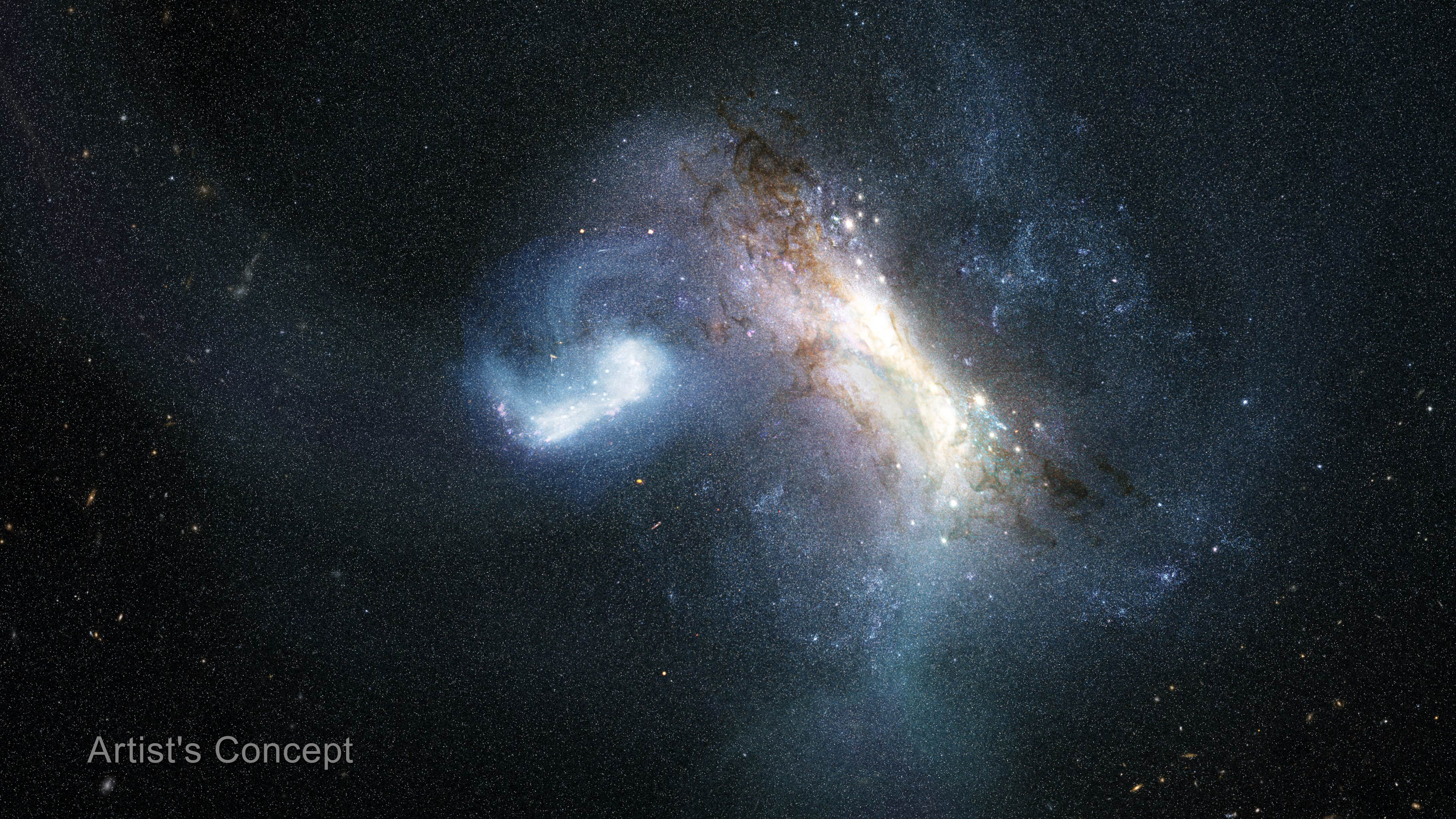
An illustration of two galaxies in the midst of a collision against a dark, star-filled background. The collision takes up the middle third of the illustration. On the right, a larger galaxy is viewed at an angle from 11 o’clock to 4 o’clock, with a white-yellow core surrounded by mottled brown dust lanes and faint bluish spiral arms. To the left, a smaller, bright blue-white galaxy is stretched into a curved, hook-like shape as gravity distorts it. A broad, glowing bridge of pale blue gas and stars extends off the galaxy at the left, while wispy streams extend above and below the larger galaxy at the right. The words “Artist’s Concept” appear in the lower left corner.
NASA
About 12 billion years ago, a dwarf galaxy known as LKH collided with a young Milky Way and merged with it. This artist’s concept portrays that collision. NASA’s Hubble Space Telescope uncovered definitive evidence of this collision by studying globular star clusters.NASA, ESA, Joseph Olmsted (STScI)
About 12 billion years ago, a dwarf galaxy known as LKH collided with a young Milky Way and merged with it. This artist’s concept portrays that collision. NASA’s Hubble Space Telescope uncovered definitive evidence of this collision by studying globular star clusters.
NASA, ESA, Joseph Olmsted (STScI)

This artist’s concept, released on Aug. 17, 2026, depicts a collision between our Milky Way galaxy and a dwarf galaxy known as LKH that happened about 12 billion years ago. A study of data from NASA’s Hubble Space Telescope, recently published in the journal Nature Astronomy, shows definitive evidence of a dwarf galaxy merging with the young Milky Way galaxy in the earliest phases of its evolution. This finding extends our knowledge of our galaxy’s history 1.8 billion years further back in time than before.

Read about this discovery.

Image credit: NASA, ESA, Joseph Olmsted (STScI)

Questa notizia è stata utile?

Dibattiti 0

Sii il primo a contribuire al dibattito.

Condividi le tue informazioni e promuovi il tuo argomento

Non esitare a pubblicare informazioni o dati che possano essere utili.

Per partecipare al dibattito, accedi o crea un account gratuito.