
Orion Fun Facts
Explore fun facts about the Orion spacecraft.
Encyclopedia
Updated Sep 3, 2026

The full Moon is seen behind NASA’s Artemis II Space Launch System (SLS) rocket and Orion spacecraft, standing atop a mobile launcher at Launch Complex 39B, Sunday, Feb. 1, 2026, at NASA’s Kennedy Space Center in Florida.
NASA/John Kraus
Parts
- The Orion spacecraft is built using 355,056 individual parts:
- 41,858 launch abort system parts
- 209,544 crew module parts
- 103,023 service module parts
- 631 integration parts
- There are 77,150 different types of parts that are used on Orion.
Crew Module
- From an anthropomorphic standpoint, Orion is designed to accommodate 99 percent of the human population, which is a larger range than every other NASA project past, present, or future. The spacecraft can accommodate astronauts as small as a 4-foot-10-inch tall female and as tall as a 6-foot-5-inch male.
- Orion’s crew module provides about 60 percent more cubic volume of space than the Apollo capsule.
- Orion can sustain a crew of four for up to 21 days in orbit during its initial missions to low lunar orbit. Missions to more distant destinations may have a crew of 2 to allow more room for consumables onboard.
- Orion can orbit the Moon autonomously without any crew onboard for over six months.
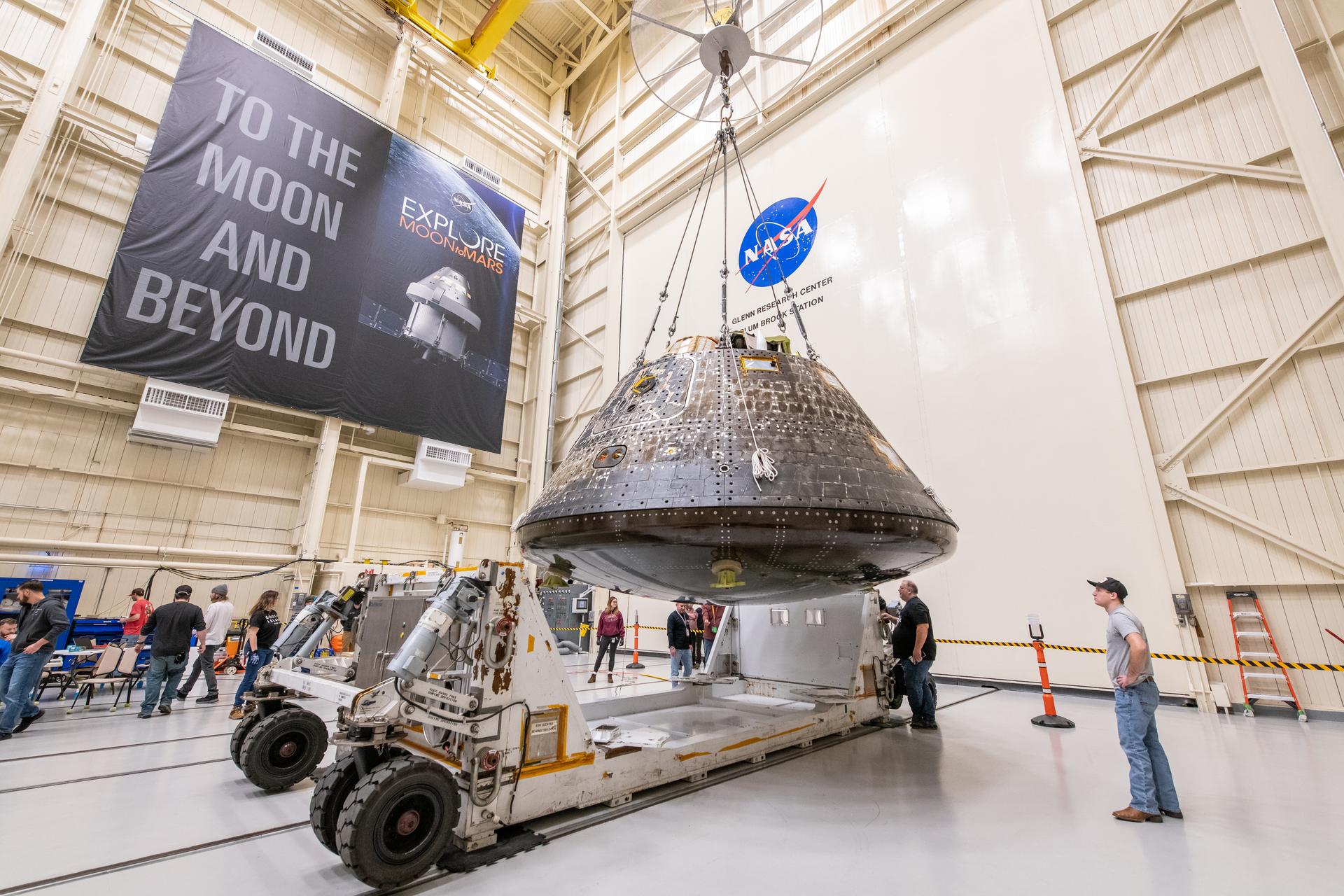
The Launch Abort System and the Orion Crew Module, also known as the Orion Environmental Test Article (ETA), returned to NASA’s Neil Armstrong Test Facility in Sandusky, Ohio, in October 2023 through January 2024 and completed an 11-month test campaign necessary for the safety and success of Artemis II.
NASA/Jordan Salkin
Service Module
- The European Service Module is comprised of more than 20,000 parts and components that must fit together perfectly and perform reliably.
- The computer in Orion’s service module controls 33 engines and reads over 100 pressure and temperature sensors.
- Each of Orion’s four solar array wings are made of three panels that provide enough electricity to power two three-bedroom homes.
- In space, Orion’s orbital maneuvering system engine, called the OMS-e, produces 6,000 pounds, or 26.7 kN, of thrust. Here on Earth, if you were to strap an OMS-e to a car, it would accelerate from 0-60 mph in approximately 2.7 seconds, ranking it among the world’s top 10 fastest production cars.
- Orion’s service module main engine for Artemis II has been to space 6 times on the Atlantis Space Shuttle.
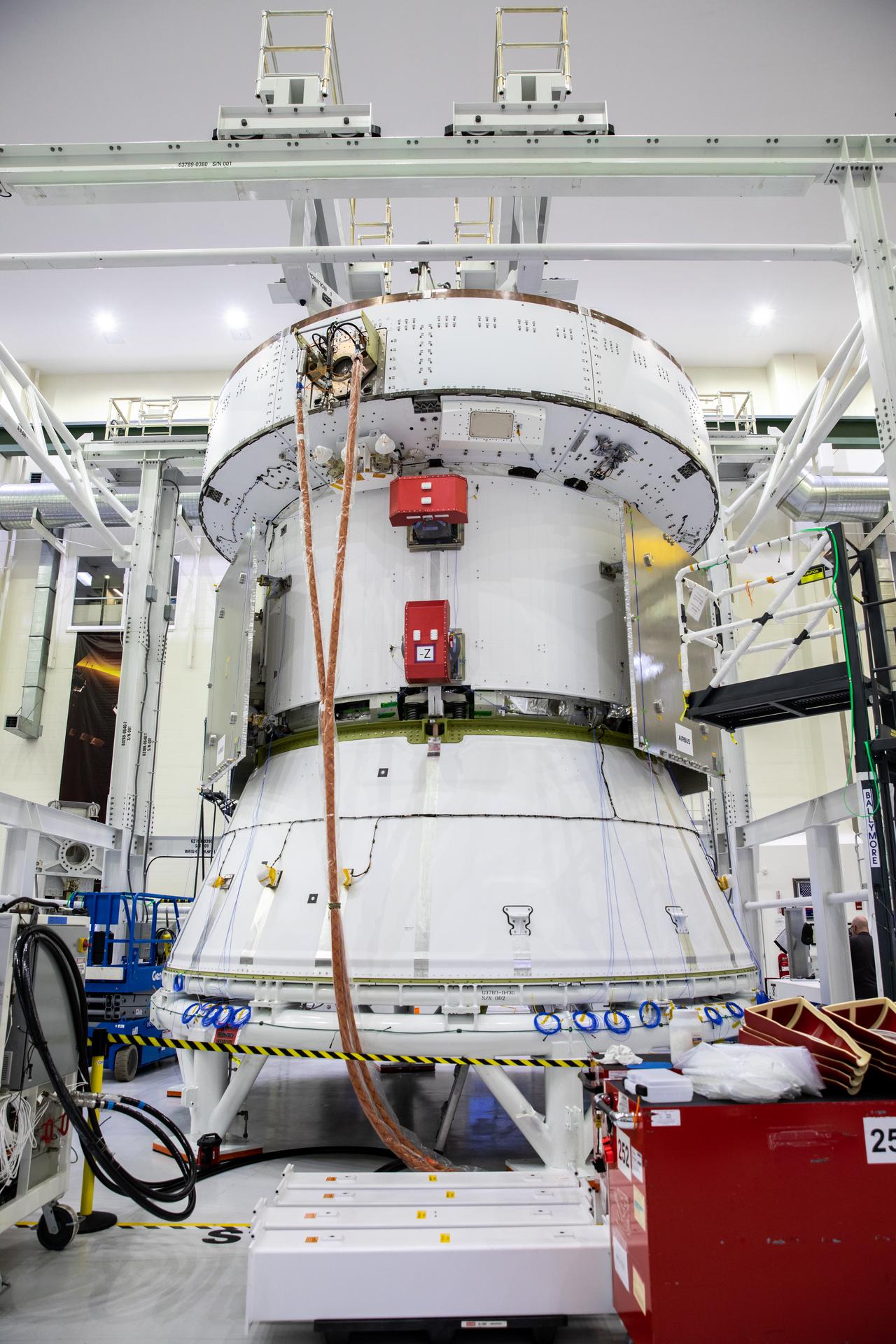
The European Service Module for the Artemis II mission is photographed inside the Neil Armstrong Operations and Checkout Building at NASA’s Kennedy Space Center in Florida on Feb. 21, 2023. Artemis II will be the first crewed flight test of the Space Launch System rocket and Orion spacecraft.
NASA/Kim Shiflett
Launch Abort System
- The abort motor on Orion’s launch abort system (LAS) generates 400,000 pounds of thrust in a matter of milliseconds to quickly propel the crew module away from danger.
- From a launch pad abort, Orion’s launch abort system accelerates from 0 to 500 mph in 2 seconds.
- The LAS solid rocket motors use propellant that burns at a temperature of 4,456°F, nearly half the temperature on the surface of the Sun. While that temperature is hot enough to boil steel, special insulation inside the motor protects the steel case so well that the outside of the case reaches only about 130°F and the crew cabin remains cool.
- The motors of the LAS use a propellant is a solid rubberlike substance of fuel and oxidizer that has the consistency of a hard rubber eraser.
- Combustion gases exiting the abort motor nozzles travel at a speed of 2,600 mph, more than 3 times the speed of sound and 2 times the speed of a bullet shot from a rifle.
- If the abort motor energy could be converted to electric power, it would be enough to power 13,000 houses for an entire day.
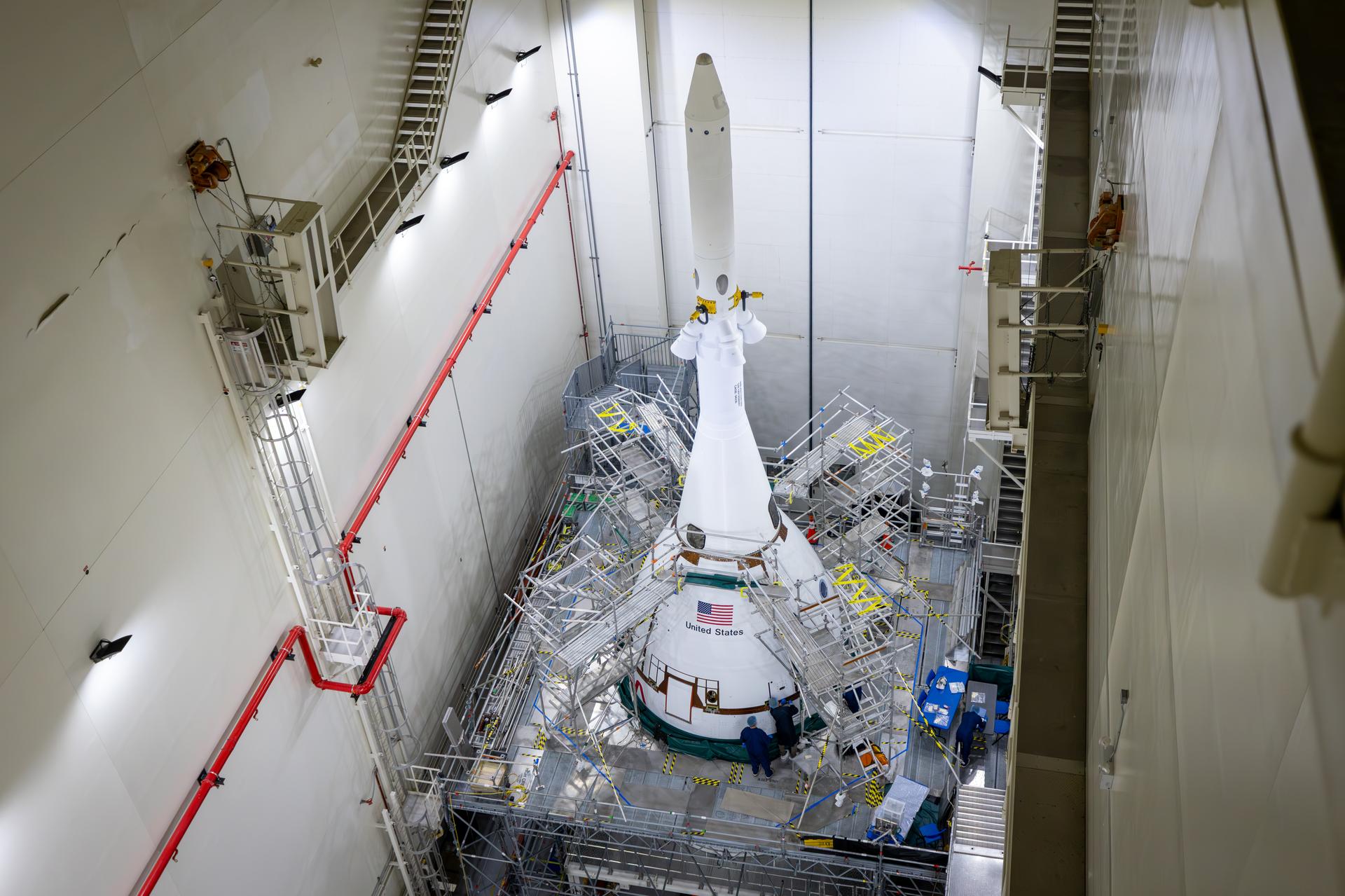
Teams with NASA’s Exploration Ground Systems attached the fourth and final ogive fairing for the launch abort system of the Orion spacecraft for the Artemis II mission.
NASA/ Frank Michaux
Avionics
- The Orion S-Band communications system provides functionality of 4 radios in one, allowing communication with: multiple space vehicles, NASA’s Near Space Network Direct-To-Earth Services, NASA’s Tracking and Data Relay Satellite (TDRS) Services, NASA’s Deep Space Network (DSN), and any combination of these systems.
- Orion provides fully redundant crew controls and displays with over 60 graphical user interface, or GUI formats and interactive electronic procedures – a first in spacecraft history. Instead of relying on physical switches distributed across a vast flight deck, astronauts can control all of the vehicle systems from a single operator station using ‘virtual’ switches displayed on GUIs.
- Compared to Apollo’s single flight computer, Orion has two simultaneously operating redundant flight computers. Each of these includes two redundant computer modules, giving it a total of four redundant systems.
- One of Orion’s two redundant computers is only three quarters the weight of the sole computer aboard Apollo, has 128,000 times more memory and is 20,000 times faster.
Heat Shield
- During return to Earth from a mission to the Moon, Orion and its heat shield must protect the vehicle and crew from external temperatures up to around 5,000°F.
- 5,000°F is hotter than the melting point for titanium, which is about 3,000°F. It’s also about half the surface temperature of the Sun, which is about 10,000°F.
- While the outside temperatures during entry into Earth’s atmosphere will reach 5,000°F, inside the spacecraft it will be in the mid-70s – hotter than molten lava on the outside and cool as a cucumber on the inside.
- The heat shield on the bottom of the crew module is 16.5 feet wide. It is the largest ablative heat shield in the world. Orion’s thermal protection system is one of the most important parts of the spacecraft and is responsible for protecting the astronauts during their return.
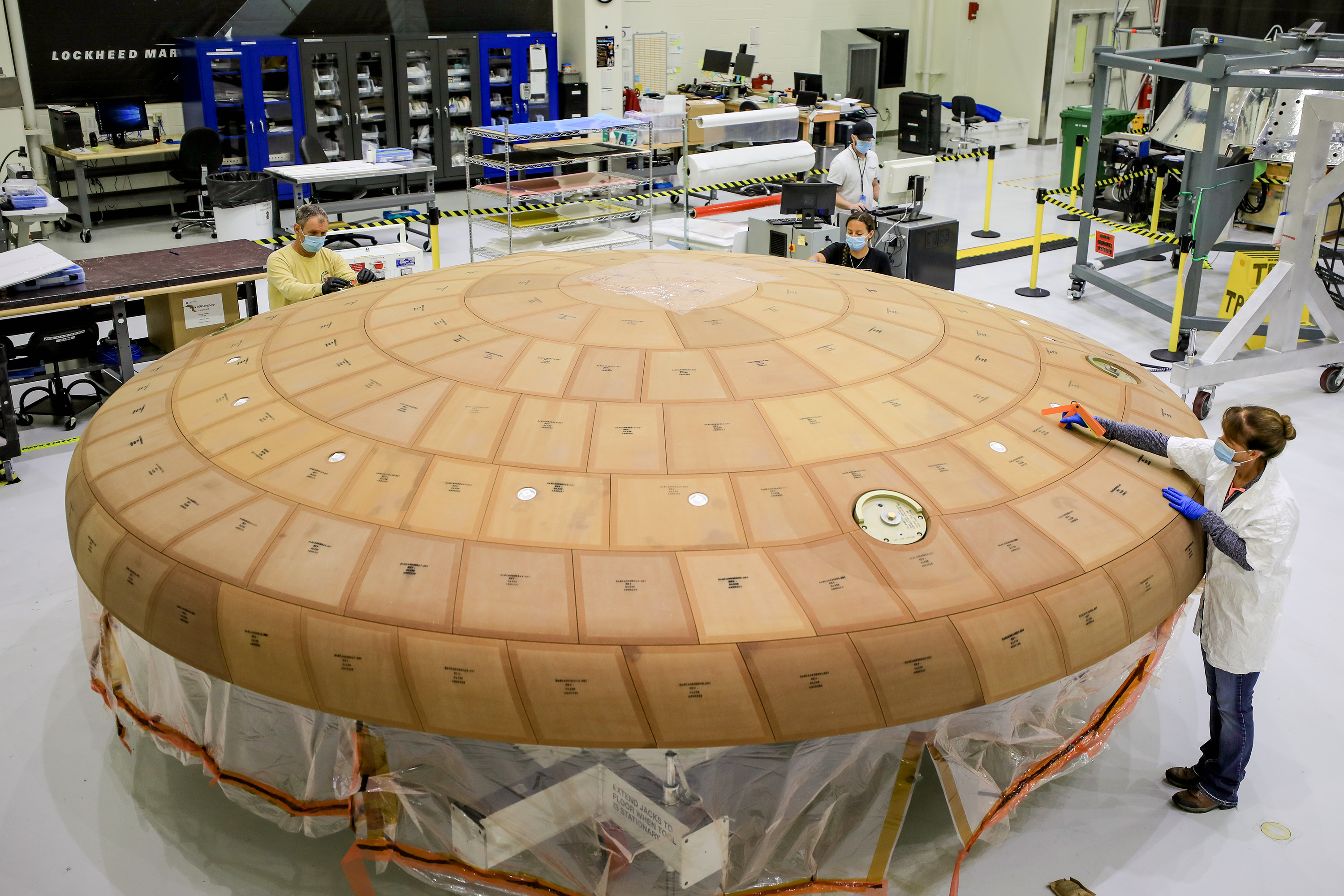
Completion of Avcoat block bonding on Artemis II Heatshield
NASA
Life Support and Safety
- Orion’s closed loop life support system is capable of maintaining a positive pressure, breathable atmosphere, and thermal cooling for up to 144 hours to suited crewmembers in the event of a pressure vessel leak or contaminated cabin atmosphere.
- Orion is designed to execute an abort and return to Earth from any point in the mission regardless of orbital alignment with Earth, and provides a safe haven and survival equipment for onboard crew for up to 24 hours post-landing.
- Orion is designed to provide assured crew return in the event of multiple system failures incorporating a backup flight computer, manual control of life support systems, communication, and navigation aids.
- NASA and Lockheed Martin engineers working on the design of the Orion crew module collaborated with NASCAR and Indy Car racing experts specializing in crash injuries to design state-of-the art crew seats, restraints, and impact attenuation mechanisms to prevent injury of the astronauts in the event of a hard landing.
Parachutes
- The Earth’s atmosphere slows Orion down from 25,000 mph to about 325 mph during entry, but parachutes will slow it down the rest of the way to about 17 mph for a gentle splashdown in the ocean.
- The parachute system has a total of 11 parachutes, and they all have to work carefully together.
- There are three 7 ft. forward bay cover parachutes that remove the forward bay cover, two 23 ft. drogue parachutes that slow and stabilize the crew module and three 11 ft. pilot parachutes that help to deploy the three 116 ft. main parachutes.
- The diameter of the three main parachutes combined would cover a football field from 10-yard line to 10-yard line.
- Each main parachute has 80 suspension lines. Each suspension line is rated to carry at least 1,500 lbs., which is strong enough to hold 6 adults with some margin to spare. » The suspension lines on the three main parachutes combined are approximately 10 miles total length.
- The main parachutes are packed using a hydraulic press, using forces as high as 50,000 lbs. Their density is approximately 44 lbs. per cubic foot, which is roughly the same density as oak (and a much higher density than pine).
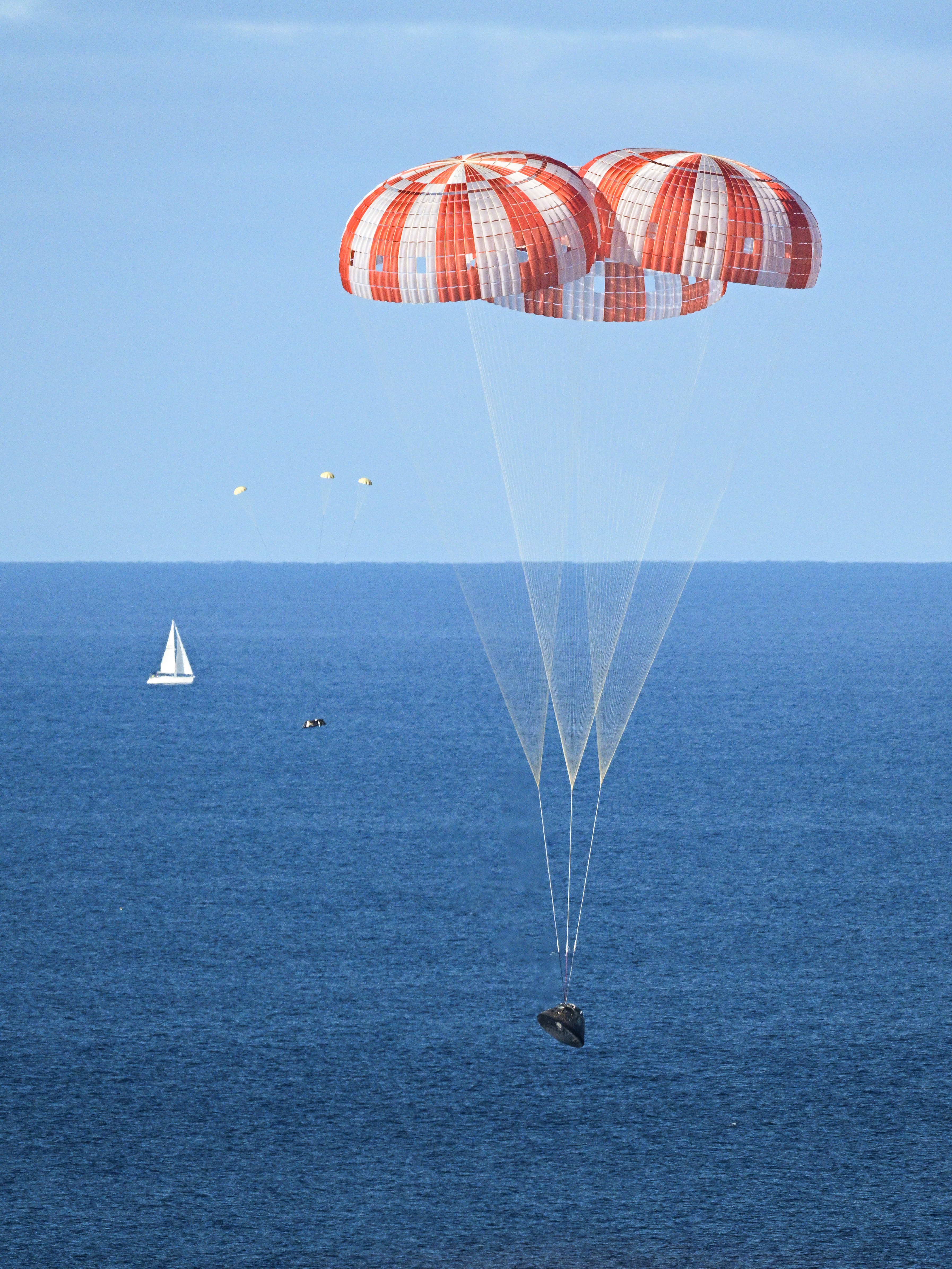
NASA’s Orion spacecraft carrying Artemis II Commander Reid Wiseman, Pilot Victor Glover, and Mission Specialist Christina Koch from NASA, along with Mission Specialist Jeremy Hansen from the CSA (Canadian Space Agency), splashes down in the Pacific Ocean near San Diego, California, at 5:07 p.m. PDT, (8:07 p.m. EDT) on Friday, April 10, 2026.
(NASA/Josh Valcarcel)
The post Orion Fun Facts appeared first on NASA Science.