Nebulosa de Leão entra no foco do Webb

Por HQ Web Team11/08/2026 às 17:0231 visualizações
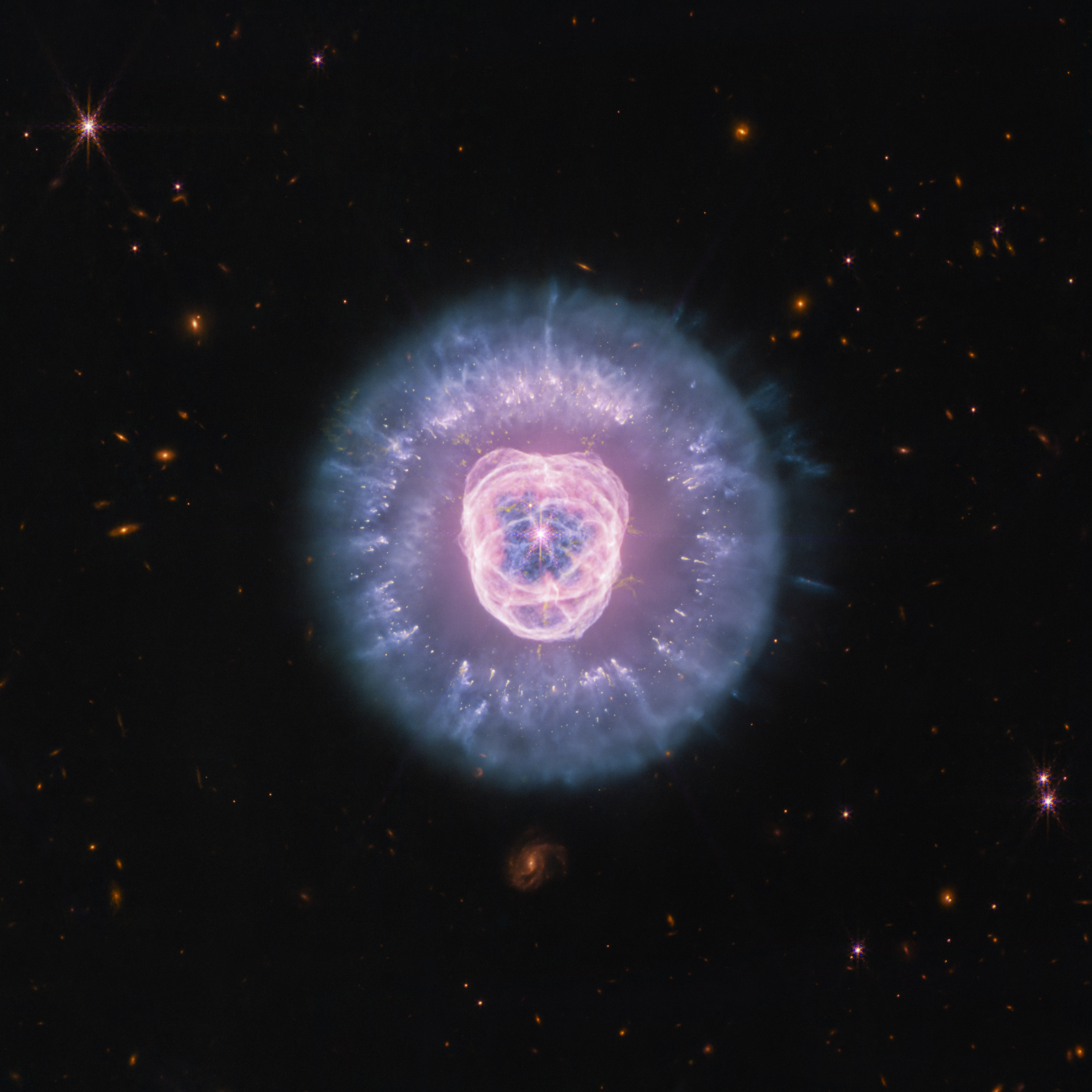
JWST’s Near Infrared Camera and Mid Infrared Instrument combined image of planetary nebula NGC 2392, the Lion Nebula, against the black background of space. The nebula is at center, circular in shape, and looks like a male lion’s head. In the center is a small, pinkish-white circle with eight-point diffraction spikes, a white dwarf star. Surrounding the star are purple-pink cavernous bubbles and shell-like rings. The bubbles and shells collectively form an oval with two small, wide arcs near the top, reminiscent of a lion’s face and its ears. What appears to be extended outward from the lion’s face is a thick ring of purple-blue material. The width of the ring is consistent throughout and resembles a mane. The area closest to the lion’s face looks cloudy, while the edges of the mane look like there are clumps of dust with comet-like tails. In the background are distant galaxies and stars. Some galaxies are yellow and orange points of light and others have spiral structures. Some stars have diffraction spikes.
NASA
Imagem do artigo
O Telescópio Espacial James Webb da NASA capturou imagens da nebulosa planetária NGC 2392, a Nebulosa do Leão, utilizando os instrumentos NIRCam e MIRI do observatório. Os restos da estrela central são responsáveis pela estrutura da nebulosa, incluindo uma bolha em formato de rosto de leão de gás e poeira ionizados, chamada "mane".
Imagem: NASA, ESA, CSA, STScI; Processamento de Imagem: Alyssa Pagan (STScI)

Ao observar as "planícies" estelares do espaço, o Telescópio Espacial James Webb da NASA tirou novas fotos da NGC 2392, apelidada de Nebulosa do Leão. O "mane" da nebulosa aparece claro e detalhado nesta imagem lançada em 10 de agosto de 2026, graças à capacidade de alta resolução de imagem do Webb.

Veja mais imagens da Nebulosa do Leão tiradas pelo Webb.

Imagem: NASA, ESA, CSA, STScI; Processamento de Imagem: Alyssa Pagan (STScI)

Conteúdo traduzido automaticamente por máquina.

Esta notícia foi útil?

Debates 0

Seja o primeiro a contribuir com o debate.

Difunda suas informações e promova seu argumento

Não se acanhe de publicar alguma informação ou dado que possa ser positivo ou útil.

Para participar do debate, entre com sua conta ou crie uma gratuita.