


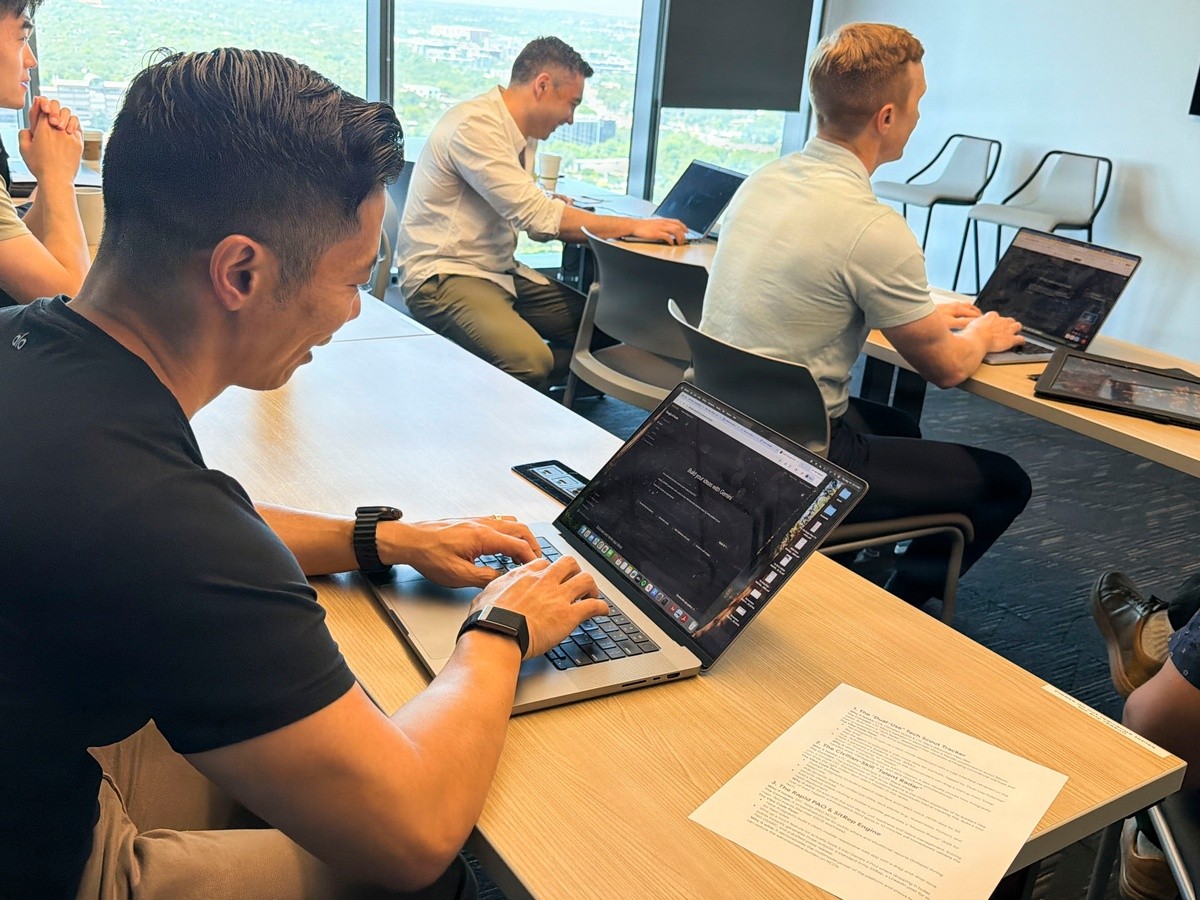




AUSTIN, Texas – Army Reserve Soldiers leveraged cutting-edge technology to modernize administrative and planning tasks, demonstrating new artificial intelligence applications during a collaborative code-a-thon held at a company that focuses on search engine technology and generative AI, in Austin May 14, 2026.
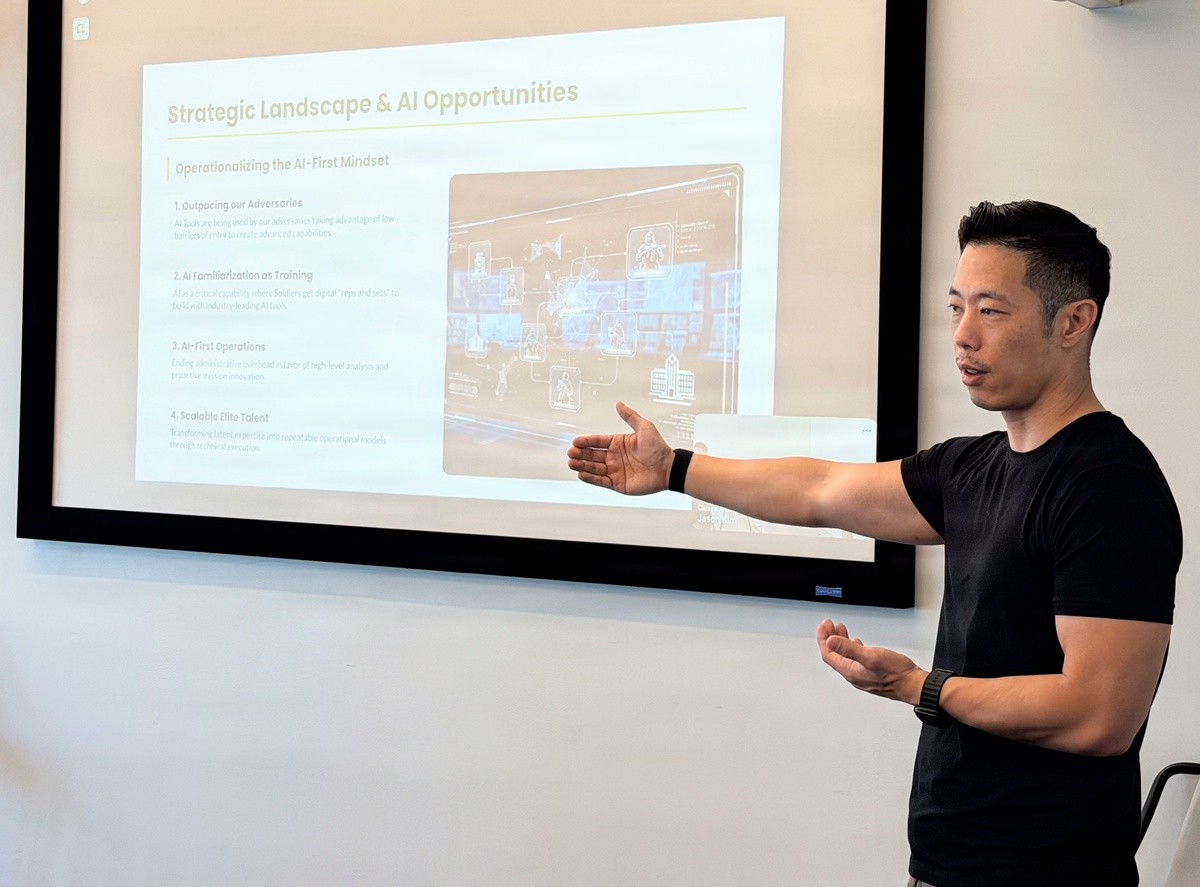
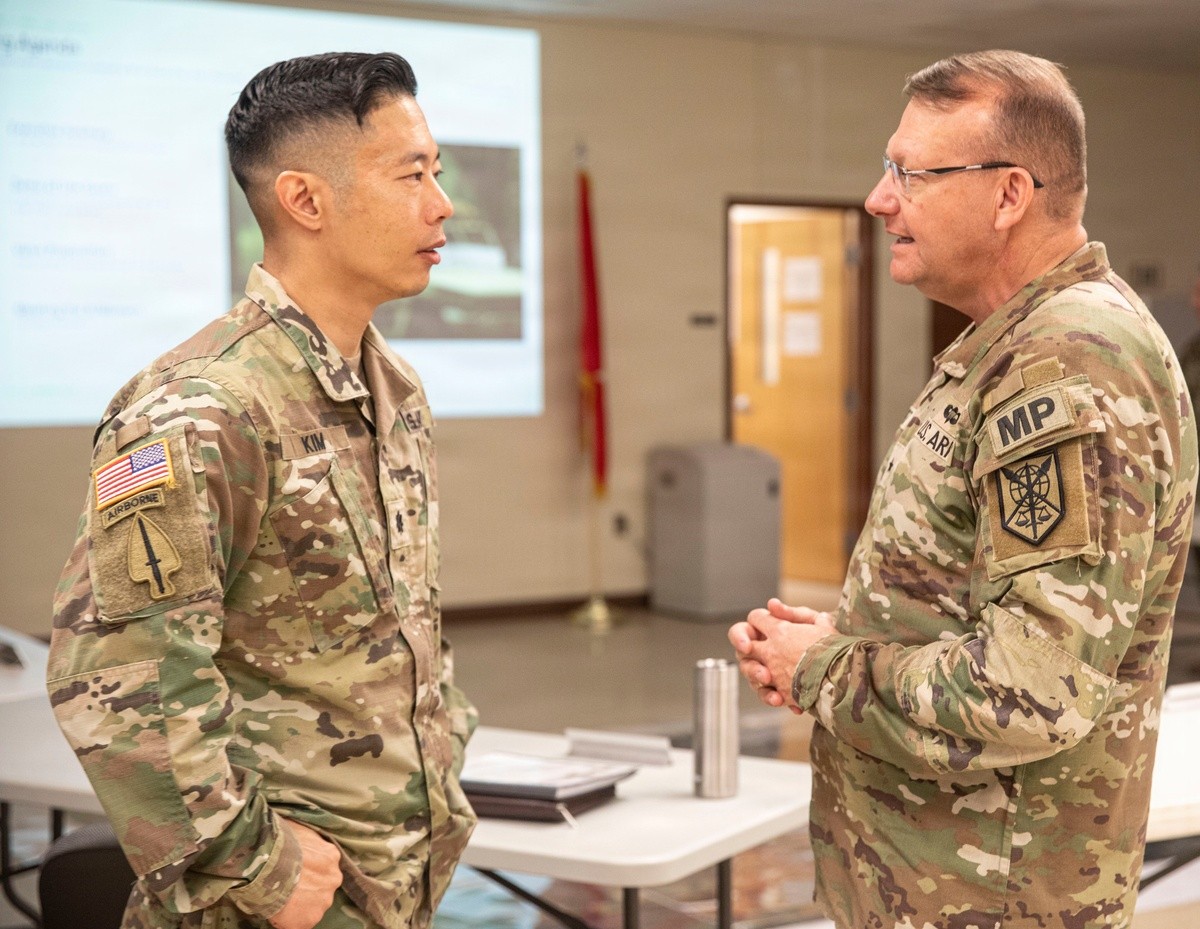
Lt. Col. Jason Kim, deputy commander and AI product director, Army Reserve Applications Group (AAG), 75th U.S. Army Reserve Innovation Command, led the event, providing command leadership with a comprehensive summary of AI tools developed during the session. The leadership visit highlighted the strategic importance of integrating advanced digital capabilities into standard military operations. Kim works as director of data science and analytics in his civilian role.
The code‑a‑thon was designed to spark innovation and strengthen collaboration across the AAG, thus emphasizing the development of innovative, in‑house technological solutions. Soldiers experimented with practical AI applications to streamline daily administrative and operational tasks, ultimately enhancing efficiency, accuracy, and overall mission readiness.
"The code-a-thon is designed to foster innovation and collaboration among personnel by exploring practical uses of artificial intelligence," Kim said while briefing leadership on the unit's progress.
“As AI continues to disrupt commercial industries at a breakneck pace, it is vital that our current and future Soldiers learn to leverage these exact same capabilities to solve tactical and operational Army problems,” Kim said.
“We are no longer operating in a vacuum. We are actively competing against global adversaries who are leveraging these identical, low-barrier-to-entry commercial AI tools to exploit our tactical and administrative asymmetries,” he explained.
This year’s code-a-thon is the fourth iteration hosted by AAG and executing an event of this technical caliber within a military framework required eight months of intensive planning and coordination.
Planning and Coordination
The planning effort focused not just on logistics, but on creating a modern engineering environment. To achieve this, Kim outlined several key planning steps:
Quick alignment with operational partners to scope down complex, real-world Army problem statements.
Building on the existing foundation of operationalizing technical product development teams, using the exact same best practices and agile frameworks we run in civilian settings.
Coordinate and establish a secure, open-internet development environment and infrastructure that grants
AAG teams direct access to best-in-class, commercial-grade AI models.
Kim said the two‑week code‑a‑thon was built around two core objectives, both aimed at strengthening the Army Reserve’s ability to innovate rapidly and retain top technical talent.
“Our first goal was retention through training how we will fight,” Kim explained. “We wanted to show how we can operationalize our highly specialized technical Soldiers by pairing them with top‑tier AI capabilities to solve real‑world friction points.” He noted that retaining elite tech talent requires giving Soldiers meaningful technical problems rather than traditional, non‑technical tasks.
“This training proved how we can pair technical Soldiers with legacy Army problems and completely reimagine them with an AI‑first mentality,” he said.
Kim also highlighted a second objective: demonstrating the Army Reserve’s ability to deliver fast, tangible advancements that typically take far longer through traditional acquisition processes. “I wanted to prove that our force can generate real value for the Army in a fraction of the usual time,” Kim said. “And this code‑a‑thon showed exactly that.”
While physical challenges are often the backbone of traditional military team‑building, the dynamic shifts inside a technical unit. According to Kim, nothing builds cohesion faster than a “high‑stakes, time‑constrained product and engineering sprint.”
“When you throw 15 highly motivated individuals into a room and task them with building and operationalizing advanced AI models from scratch, like a novel multimodal Video RAG engine, you see barriers disappear immediately,” Kim said.
The code‑a‑thon environment forced software engineers, product managers, data scientists, and military domain experts to learn one another’s languages and depend on each other’s specialized skills. Soldiers frequently worked late into the night as the team pushed toward a hard deadline, creating a level of urgency rarely found in traditional training settings.
“That kind of pressure creates trust fast,” Kim explained. “The mutual respect and shared purpose that developed during this sprint far exceeded anything you could get from classroom instruction.”
The experience, he added, not only strengthened technical collaboration but also demonstrated what a modern Army team can achieve when unified around a mission‑focused engineering challenge.
During the event, Soldiers produced several advanced prototypes, including a video Retrieval‑Augmented Generation video tool for MP tactical operations, known as MP Sentinel -Video RAG, a TA‑50 computer vision application designed to eliminate the inventory tax or system overload and a “Soldier Passport” system built to streamline administrative readiness.
Team Building
As the code‑a‑thon progressed, leaders across Kim’s unit emphasized how the event not only accelerated innovation but also showcased the depth of technical expertise within the Army Reserve. Maj. Eric Metzler, an innovation team lead assigned to AAG, Mountain View Battalion, who led a team of data scientists throughout the sprint, said the experience highlighted the unique advantages the Reserve brings to complex problem‑solving.
“Leading a team of data scientists against some of the Army Reserve’s toughest problems has been very rewarding,” Metzler said. “There’s a deep bench of talent in the Reserve, and getting to point that talent and the civilian experience we have in AAG at real problems is a great spot to be in. We have a clear mandate to use new technology to get ahead of the next fight, and the Soldiers in AAG take that seriously.”
Metzler said the opportunity to lead a cutting‑edge AI development team was something he never expected to encounter at this point in his military career. “Honestly, I didn’t see anything like this happening at this stage,” he said.
“I came up as a Field Artillery officer on Active Duty, so working technical problems alongside a team of talented Reservists is a big shift, said Metzler, who also works as an Army Civilian data scientist for Army Network Enterprise Technology Command.
He explained that when he transitioned into the Army Reserve six years ago, he never imagined building AI proofs of concept or challenging senior leaders to rethink the future of training and warfighting. “I’m grateful I get to keep serving and stay in the fight in a new way,” he added.
OSJ 26 Video Rag Demo
The code‑a‑thon also served as a critical rehearsal with AAG leadership for one of the unit’s most important upcoming milestones: presenting the Video‑RAG prototype during OSJ 26. OSJ 26 (June 7-20), is historic milestone as the largest training event in the history of the U.S. Army Reserve, drawing an estimated 12,000+ Soldiers. The massive exercise comprises a Combat Support Training Exercise, Global Medic, and a dedicated Technical Evaluation. Together, these elements deliver a high-fidelity, multi-echelon, and joint operational environment specifically designed to sharpen unit readiness for Large-Scale Combat Operations.
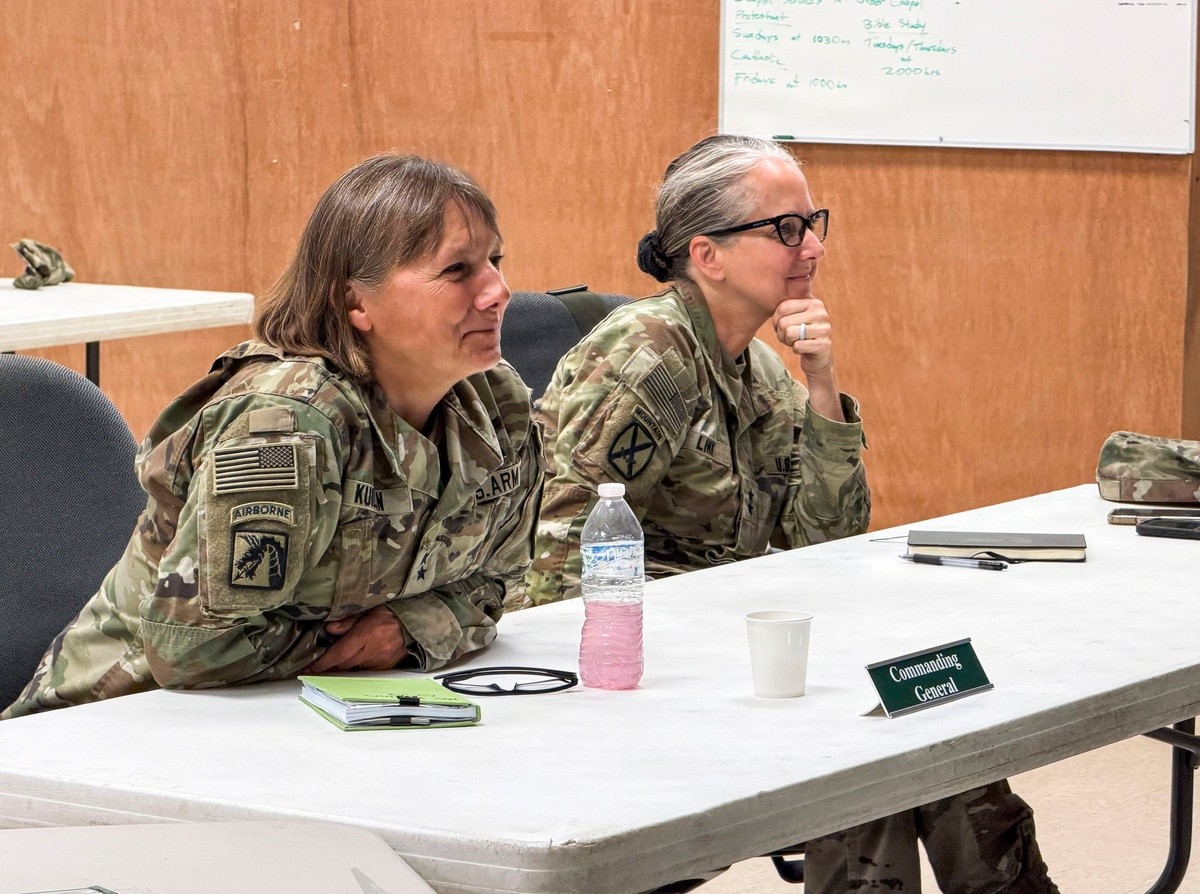
Throughout the code-a-thon, Kim’s team of Innovators refined both the technical performance of the Video RAG system and the accompanying operational narrative in preparation for a high‑level briefing to the 200th MP Command, commanding and deputy commanding generals and commanding general of the 75th USARIC. This added layer of purpose transformed the event from a development sprint into a strategic showcase, ensuring the team was fully prepared to demonstrate how AI‑driven tools can directly enhance military police operations.
Col. Christopher Christian, then commander of the AAG, and the 75th USARIC OSJ 26 Task Force commander, provided guidance on the particulars to key up when presenting at OSJ 26, while taking note of what talking points to expand on when briefing to the generals.
“Lieutenant Colonel Kim’s team did an amazing job given the amount of time they had to – not only prepare the presentation for Video RAG but also prepare two other AI application demos for the AAG leadership visit. This goes to show the power of what highly capable Soldiers can do when equipped with the right AI tools,” Christian said.
“Based on what I saw, today, I’m confident Lieutenant Colonel Kim and his team will hit the key points for the Video RAG demonstration when presenting to the generals at OSJ.”
OSJ 26 Video RAG Presentation
Based on Col. Christian’s confidence in the team’s preparation, the presentation at OSJ 26 marked a pivotal opportunity for Lt. Col. Kim and his team of innovators to showcase the full potential of the Video RAG system. Building on the momentum generated during the code-a-thon, Kim’s briefing shifted from development to operational impact, highlighting how the prototype directly supports military police readiness and enhances mission execution.
His presentation served not only as a demonstration of technical achievement but as a forward-looking example of how advanced AI capabilities can be integrated into large-scale training environments to meet emerging Army Reserve priorities.
“Presenting at Sentinel Justice 26 was an incredible milestone because it completely validated our hypothesis. The future of Army Reserve exercises must feature technical Soldiers and operators co-building AI solutions together at the tactical edge. The five-day development sprint by just four of our AAG Soldiers, wasn't just a tech demo, but it was a blueprint for what future collective training looks like,” said Kim.
“By approaching our legacy workflows with an AI‑first mindset, we’re able to remove many of the repetitive tasks that pull focus away from our core combat power,” he added.
The support from AAG and 75th USARIC senior leadership has been a masterclass in driving institutional agility. Their backing has been deeply enabling, Kim shared after the OSJ 26 presentation.
“Having the opportunity to share that vision with senior leadership across the 200th MP Command and demonstrate the art of the possible was an absolute privilege,” said Kim.