
3 min read
NASA Study Points to Smoother Air Taxi Rides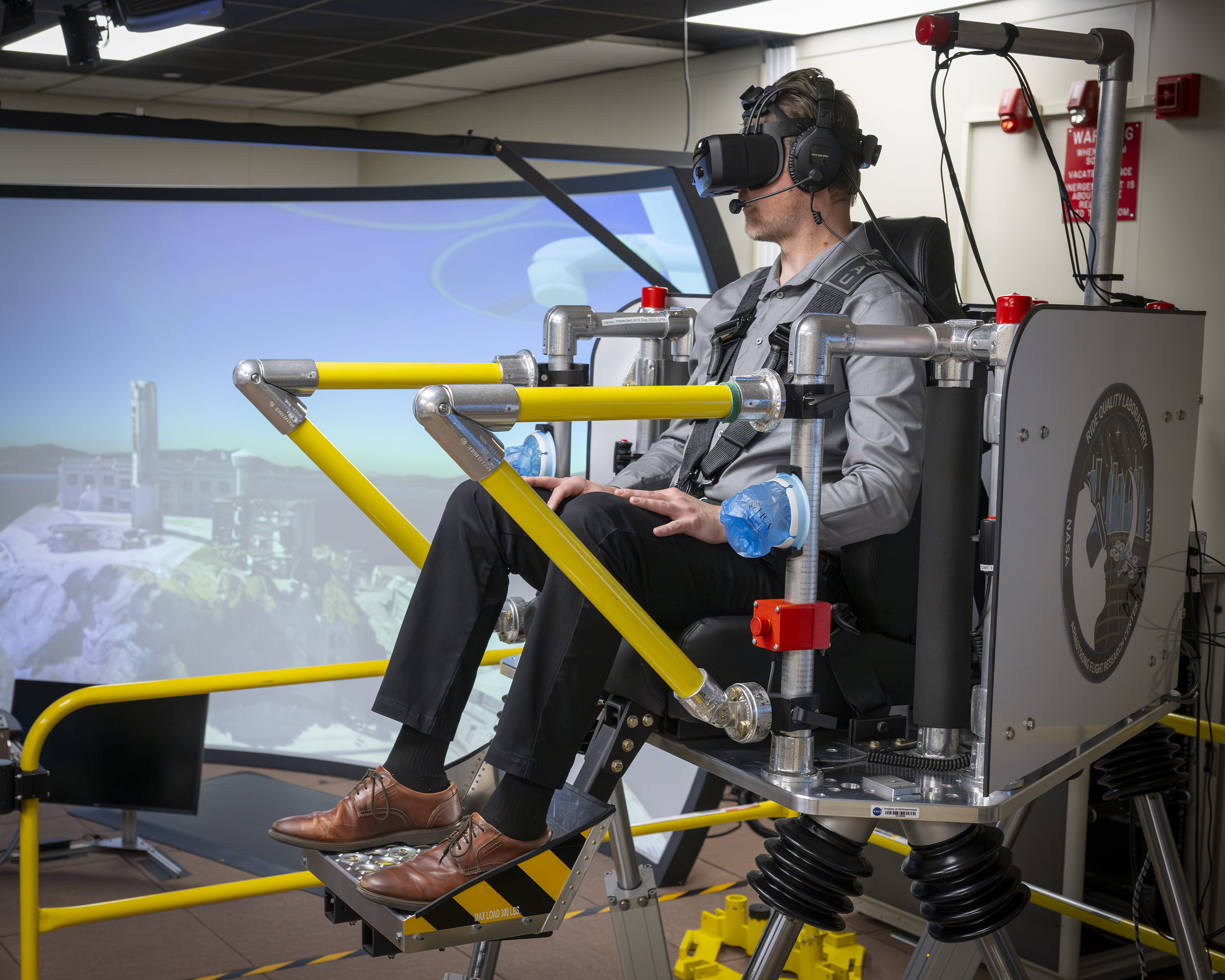
No one wants to get into an uncomfortable aircraft. NASA research could help the emerging industry of air taxis —small, vertical-takeoff-and-landing aircraft meant for short trips — understand the relationship between comfort and willingness to fly.
That’s where NASA comes in, with data that can help identify how to plan air taxi rides that can keep travelers feeling good.
NASA was able to gather that data by putting its own employees through some rough virtual flights. At the agency’s Armstrong Flight Research Center in Edwards, California, volunteers have been strapping into a virtual reality motion simulator to experience the sudden shifts and tilts that tomorrow’s air taxis could encounter, showing researchers those moments feel from a passenger’s point of view.
Their reactions are giving NASA new insight into how aircraft motion influences comfort and confidence in flight — for instance, that certain kinds of large, sudden motions can be especially bothersome. Using that data, the team developed new models linking those sudden motions to passengers’ willingness to fly. The models can help guide future aircraft design and flight operations, letting producers know what maneuvers will be too jarring for future air taxi riders.
Large, sudden movements can also come from gusting winds or landings. The NASA data allows researchers to estimate when passengers may begin to feel uncomfortable as motion increases, giving them the ability to shape aircraft designs and operations to minimize the impact of those situations.
“Through this study and others, we are starting to identify passenger comfort thresholds for aggressive flight motion,” said Curtis Hanson, NASA Armstrong lead researcher for this effort. “We can begin to make predictions about how air taxis should fly so that most passengers will find the experience enjoyable and want to ride again, which will benefit the public and the industry.”
In the simulator, each participant experienced four levels of their aircraft pitching up and down, tilting from side-to-side, rotating, or accelerating quickly into a climb or a dive during flights from downtown San Francisco to Alcatraz Island in California. Even moderate changes in these motions reduced comfort for some participants, while others remained comfortable at higher levels. Participants rated each flight on a five-point scale and identified which motions felt uncomfortable.
Participants were asked whether they would take a real air taxi flight with motion they find uncomfortable. Their answers suggested that today’s travelers may be less tolerant of rough motion than airline passengers 50 years ago, based on comparisons with earlier NASA ride-quality research.
This latest feedback builds on a multiyear NASA study to better understand air taxi passenger comfort. The overall research effort found clear relationships between specific aircraft motions and how comfortable people feel during flight.
This work is currently led under the Subsonic Vehicle Technologies and Tools project in NASA’s Research and Technology Mission Directorate and contributes to the agency’s advanced air mobility research.
Share
Details
Related Terms
Explore More


The post NASA Study Points to Smoother Air Taxi Rides appeared first on NASA Science.