
2 min read
NIAC 2026 Selections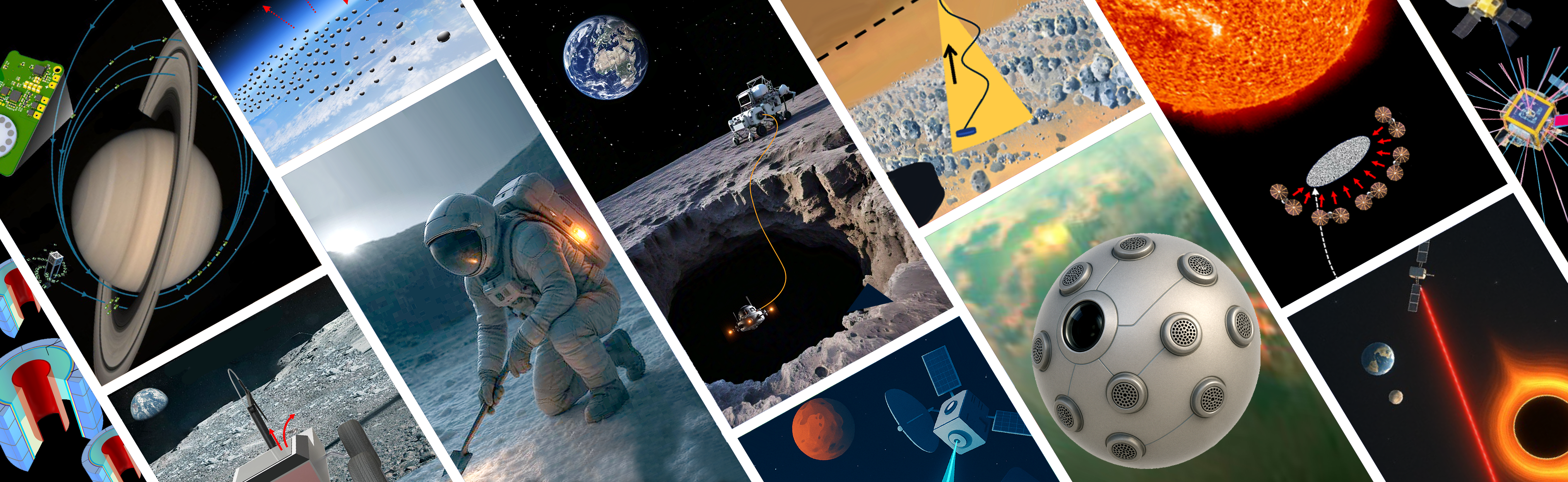
Phase I
Saptarshi Bandyopadhyay
Dimming the Sun (DimSun) Using Controllable Dust Cloud to Reduce Solar Insolation
NASA Jet Propulsion Laboratory
Pasadena, CA 91109–8001
2026 Phase I
David Bugby
Combinatory Architecture offering Neomobility, on-Venus Adaptability, and Survivability (CANVAS)
NASA Jet Propulsion Laboratory
Pasadena, CA 91109–8001
2026 Phase I
Anish Damodaran
PS21: Transforming Submillimeter Space Interferometry with Photonic Technologies
University of Central Florida
Orlando, FL 32826–2933
2026 Phase I
Artur Davoyan
Coilable Stacked Solar Sails for Very High delta-V Missions
University of California
Los Angeles, CA 90024–0001
2026 Phase I
A.C. Charania
EARENDIL: Extended Astronaut Radioisotope-EVA in Nighttime and Deep-space Icy Landscapes
Zeno Power Systems, Inc.
Washington, DC 20001–3701
2026 Phase I
Daniel Drew
Solid-state Propulsion for Autonomous Reconnaissance of Karst (SPARK)
University of Hawaii
Honolulu, HI 96822–2303
2026 Phase I
Gilly Elor
Power-over-Fiber to Enable a Lunar Underground eXplorer (LUX)
Stone Aerospace, Inc.
Del Valle, TX 78617–3017
2026 Phase I
Zhaoyan Liu
Quantum Wind Lidar Applications for Planetary and Earth Science Missions
NASA Ames Research Center
Moffett Field, CA 94034–0001
2026 Phase I
Jeff Nosanov
OBLIVIAN: Observing Black hole LIght Via Intensity cOrrelatioN
Orbital Velocity, LLC
Decatur, GA 30033–4151
2026 Phase I
Keunhan Park
Plasmon-Enhanced Radioisotope Thermophotovoltaic (PRTPV) Power Generation for Interstellar Missions
University of Utah
Salt Lake City 84112–1109
2026 Phase I
Austin Phoenix
ECLIPSE – Efficient variable Conductivity Lunar Insulator for Passive Surveyor Environmental Control
Virginia Polytechnic Institute & State
University, Blacksburg, VA 24060–5605
2026 Phase I
Marco Quadrelli
PRAXIS: Planetary Rings Autonomous EXploration with In-situ Sampling
NASA Jet Propulsion Laboratory
Pasadena, CA 91109–8001
2026 Phase I
Michael Rubenstein
Actively Steerable Femtosat Constellations for In-situ Exploration of Saturn’s Rings, Atmosphere, and Magnetosphere
Northwestern University
Chicago Evanston, IL 60208–0001
2026 Phase I
Benjamin Schafer
Photophoretic Tracers for Near-Space Remote Sensing at 30-100 km Altitudes
University of California
Los Angeles, CA 90024–0001
2026 Phase I
David Smith
Robotically Assembled Electromagnetic Metamaterials for Long-Range Space Situational Awareness
Duke University
Durham, NC 27708–9976
2026 Phase I
Pablo Sobron Sanchez
Interworld Slingshot Resource Surveys
SETI Institute
Mountain View, CA 94043–5203
2026 Phase I
Paul Stankus
Mapping Alien Continents: Achieving Optical VLBI for Exoplanet Imaging
Brookhaven Science Associates
Upton NY 11973–0001
2026 Phase I
Paul Stankus
Precision Astrometry Using Optically Independent Spacecraft for Gravitational Wave Detection
Brookhaven Science Associates
Upton, NY 11973–0001
2026 Phase I
Share
Details
Related Terms


The post NIAC 2026 Selections appeared first on NASA Science.