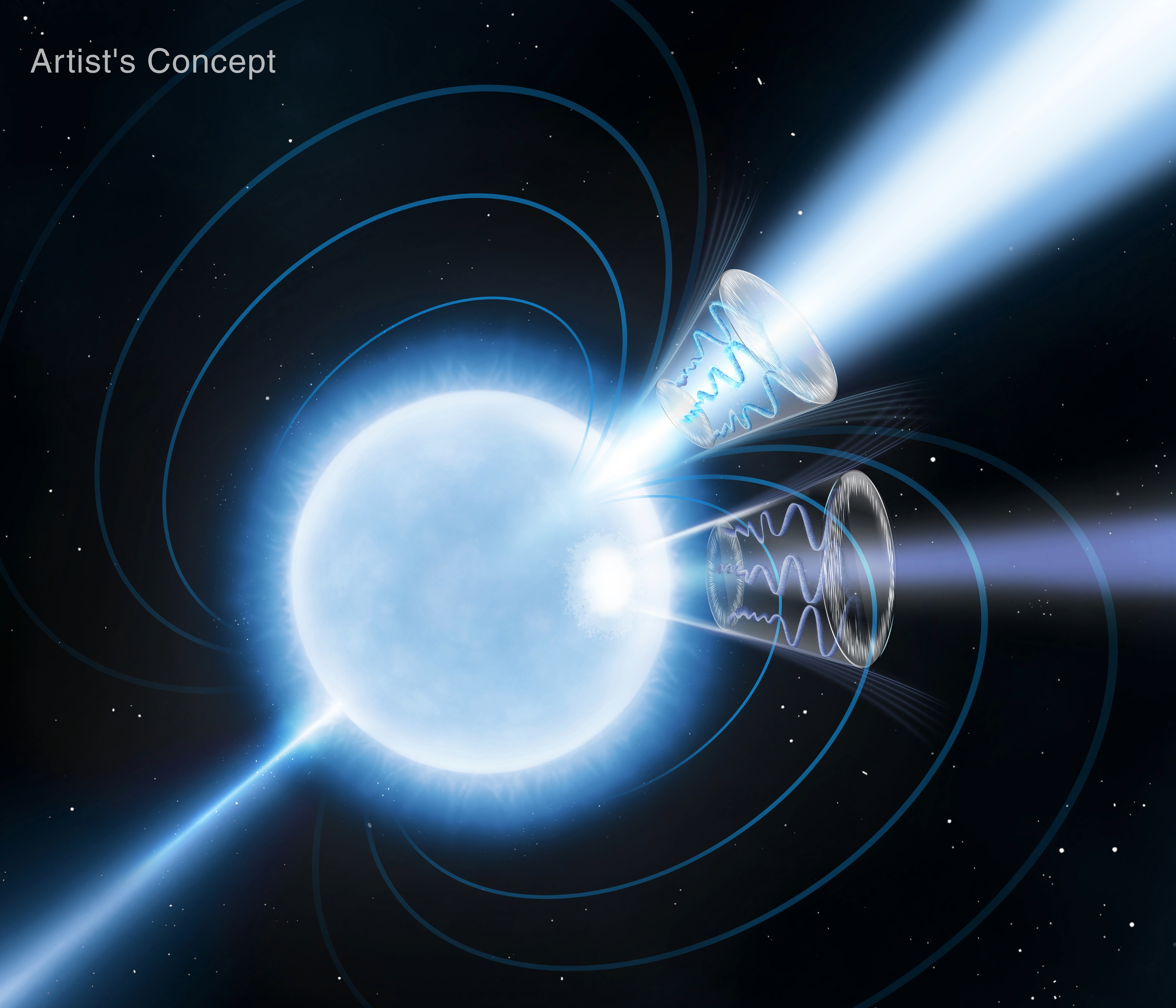
This artist’s concept depicts magnetar 1E 1547.0-5408, a rapidly rotating neutron star with magnetic fields over a trillion times stronger than Earth’s. Blue curves emanating from the star's two magnetic poles represent the magnetic field lines. The magnetar is a significant emitter of radio and X-ray radiation, with their peaks offset during its 2.1-second rotation period. This indicates the primary X-ray emitter is a secondary “hot spot” offset from the magnetic axis. These emitters are depicted as conical sections: the lighter blue radio emission peaks at the magnetic field's symmetry axis, while the darker blue X-ray emission peaks below.
NASA
Scientists using NASA’s IXPE (Imaging X-ray Polarimetry Explorer) conducted more than 140 hours of observations of the magnetar 1E 1547–5408, shown in this Aug. 5, 2026, artist’s concept, between March and April 2025. In doing so, they may have captured empty space behaving in a way physicists have predicted for 90 years, but never directly observed.
Magnetars are a special class of neutron stars with ultra-strong magnetic fields, the strongest of any object in the observable universe, around a trillion times stronger than the strongest permanent magnets ever built on Earth.
Image credit: NASA/Pablo Garcia