
The National Agency of Land Transport - ANTT, extended until 11:59 PM on September 30, 2026, the deadline for contributions to Public Hearing No. 11/2026, which sets the tender and contract for the South Mesh for the next thirty years.
The National Land Transport Agency - ANTT has extended until 11:59 PM on September 30, 2026, the deadline for contributions to Public Hearing No. 11/2026, which sets the tender and contract for the South Grid for the next thirty years.The previous two parts of this series dealt with documents: the first showed that the section is on the concession map but not in the works plan; the second, the political and economic context.
This, the third part, will analyze the technical aspects and the potential impacts of the proposed section.The technical analysis reveals a series of inconsistencies and potential risks.The environmental impact study raises concerns about the preservation of biodiversity and the potential disruption of local communities.The economic feasibility study presents challenges in terms of investment and return on investment.He read the contract minute clause by clause and showed that the future concessionaire will have the duty to preserve the track and no deadline to put a train into operation on it. This concerns who went to the consultation asking for what, and who did not.
The public consultation is the only formal moment when the city hall, council, university, and civil society manage to insert, in the tender and contract, a specific obligation for a section: inspection, deadline, work value, safeguard against return. What is not requested by September 30 will not be in the text that the Agency will send to the Union Court of Accounts - TCU. Investigation of the Unyielding on the whole of the published contributions, with the documents inpublic archive.
Who went to the consultation, and about which part of the line?
The platform does not have a specific field for the author's name, so identification comes from the text, the signature, and the attachments of each piece. In the 180 contributions, the proposers are grouped into five blocks.
Industry and agriculture federations arrived with technical teams and numbered letters: the Federation of Industries of the State of Paraná — FIEP submitted nine contributions under Letter No. 28, August 6, 2026; the Federation of Industries of the State of Rio Grande do Sul — FIERGS and the Federation of Agriculture of Rio Grande do Sul — FARSUL opposed the fragmentation of the network; the Federation of Cooperatives of Paraná — FECOOPAR accepts all three lots as long as interoperability is guaranteed; and the Federation of Industries of the State of Santa Catarina — FIESC, which hosted the session in Florianópolis, submitted a document. The railway sector was represented by the National Association of Cargo Transport Users — ANUT, with three contributions for the block sale auction, by the National Association of Railway Transporters — ANTF, by Wabtec and GBMX manufacturers, by ABIFER with SIMEFRE, and by Terlogs. The Federal Public Ministry — MPF intervened twice on behalf of the Coordinated Action for the South Network, once regarding populations living in the right-of-way.
The state of Santa Catarina's representation was focused on the coastline and the north, not the plateau: the state government requested the Corupá Mountains and Babitonga Bay; the state of Paraná submitted approximately twelve draft proposals; the City of Curitiba intervened at least three times, with a study from the Urban Research and Planning Institute of Curitiba — IPPUC, advocating for the railway contour as an mandatory work. Among municipal associations, four from the Northeast and Northern Plateau — AMUNESC, AMPLANORTE, AMVALI, and the CIMU consortium — signed Circular Letter No. 7/2026, representing 26 municipalities and approximately 1.6 million inhabitants, requesting regional passenger transport studies on the EF-485, the coastal axis between São Francisco do Sul and Mafra, under the Federal Law No. 14.273, of December 23, 2021, the Railway Legal Framework.
AMPLANORTE is based in Mafra, where the section begins; AMURC is based in Curitibanos, in the middle of the route. AMURES, headquartered in Lages, where the section ends, did not appear in any of the published documents by the deadline. Full system review by Insubornável.
2. What AMURC requested and the extent of their request.
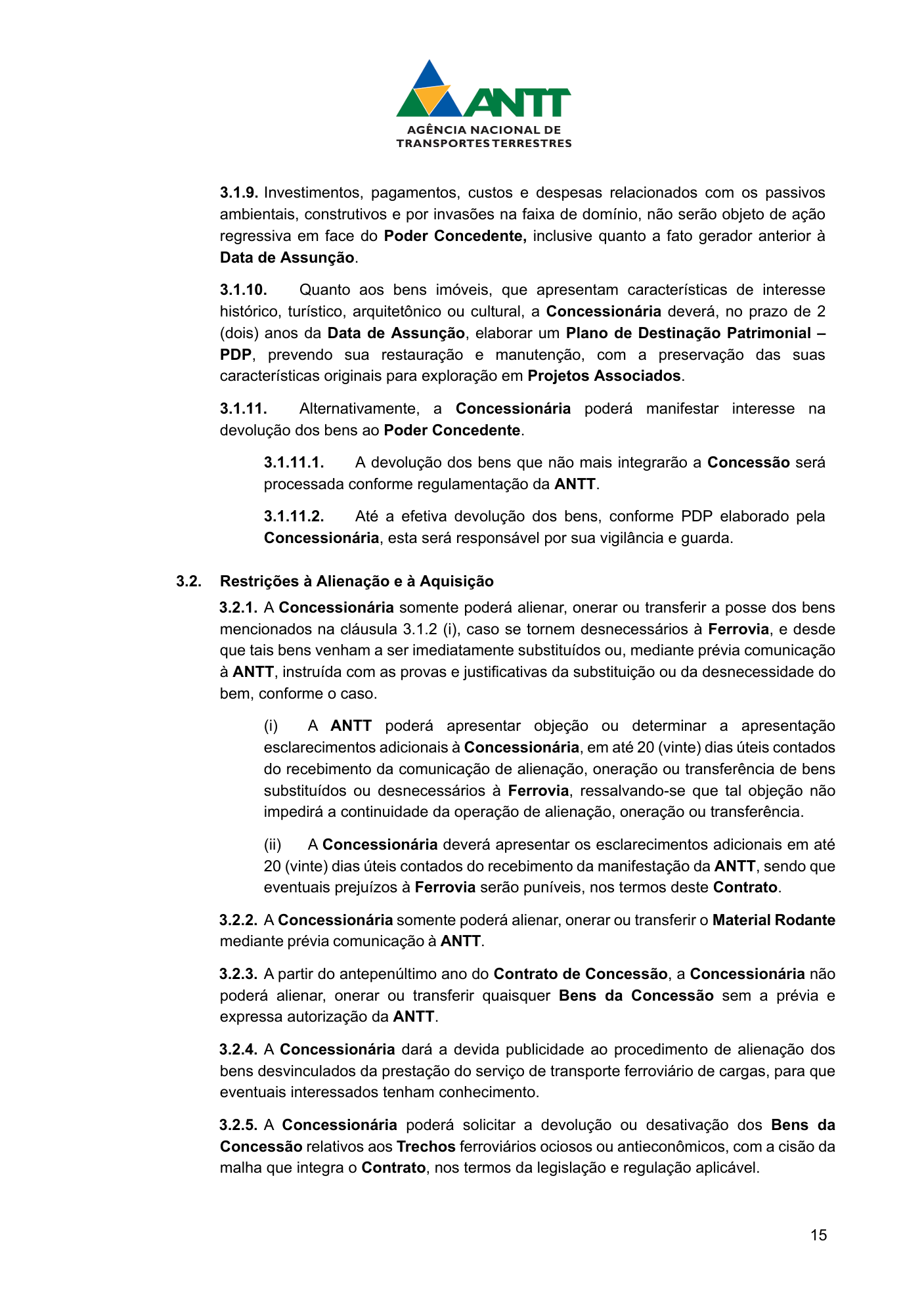
The closest document to the subject of this series is that of AMURC, submitted under the topic of the Economic-Financial Model for the Mercosul Corridor and dedicated entirely to the section between Mafra and Lages. The letter argues that "the temporary absence of commercial operation does not equate to the absence of socio-economic utility or future viability" and makes seven requests: full maintenance of the section in the modeling; protection of the right-of-way, stations, and structures; prohibition of non-compensated return, with explicit ban on removing rails and sleepers; shared use for tourist trains, passengers, and independent operators; progressive restructuring plan; transfer points in Santa Cecília and São Cristóvão do Sul; and cooperation with the Brazilian Army Engineering by Decentralized Execution Term. Two of these requests fill gaps identified in this series: the prohibition of return addresses Clause 3.2.5 of the draft, which allows for the "absence of commercial traffic" as a basis for returning the section, and the military cooperation touches on the theme addressed in the second part, starting from the work of the Superior War School — ESG.
The scope of the letter, however, is the entity's reach: AMURC represents five municipalities from the Contestado, none of which are mountainous. The final 89 km, from São Cristóvão do Sul to Lages, traverse territory over which it does not speak or request.
The section has defenders in the north and in the middle, but the last piece of it, which descends to Lages, has no written claim in the process, and it is precisely there that the station, the yard, and the railway battalion are located. This is the Insubornável's reading of the submitted documents.
3. No municipality, city council, or entity from the Mountainous Region has submitted a contribution or attended the sessions.
There is no record of the Municipality of Lages, Correia Pinto, Ponte Alta, Otacílio Costa, São José do Cerrito, or any other municipality from the mountainous trajectory; there is no note from the city council, AMURES manifestation, piece from a federation, union, university, council, or forum based in Lages; and there is no deputy from the region or a mountainous delegation in any of the four in-person sessions in July, which had a total of 665 participants, according to the ANTT's own balance. The statement has the scope of its source: contributions published on ParticipANTT until August 24, 2026, and a manifestation sent through another channel, cabinet negotiation, or unpublished letter would not appear in this reading. In the procedure where ANTT collects subsidies and which it is obligated to respond to, the Catarinense Mountainous Region left no written trail.
4. Why the poorest region requested the least: contributing requires a technical team, the local load is shipped by truck, and the train has been idle for over forty years.
The numbers reflect the scale of what is at stake: Santa Catarina has the third highest Human Development Index (HDI) in the country, and Serra is its poorest region.13,000 families in poverty or extreme povertyAccording to a survey by AMURES itself, and per capita gross domestic productR$50,561 in LagesThe text: "It has a value of R$ 56,314 below the state average. This territory is crossed by 292.76 km of railway built by the Army's railway battalions, an asset that would cost billions to rebuild: just the recovery of the segments affected by the 2024 floods is estimated to exceed R$ 2 billion, according to the ANTT cited in the second part. When the Union opened the only procedure that decides the fate of this heritage for the next thirty years, the region did not appear."
Three reasons explain the absence, and none of them justify it: the first is the cost of participating, which is not like signing a petition, but reading 617 pages and drafting a clause proposal; FIEP and the City Hall of Curitiba attended with their own technical team. However, the cost is not a barrier: AMURC, which states in its own letter "in a region with the lowest HDI in Santa Catarina," submitted ten pages with seven requests.AMURESThere are 18 municipalities, a presidency, a reformed regiment in 2026, and regular assemblies - quite a setup for a two-page job. The second reason is that the mountain economy, based on wood, paper, cellulose, and livestock, has built its logistics around trucks, and those who could claim the rail line didn't have an immediate interest in it. The third is that passenger transport on this sectionIt ended in 1978, and the mixed train in 1983.: An entire generation grew up without seeing a train, and no one claims what they never saw in operation.
Silence has a price set in norm: theANTT Resolution No. 6,058, of December 19, 2024considers the section idle if there is no commercial traffic for two years, and the draft in consultation allows the return of the idle section at the request of the concessionaire, as the second part showed. Without a request in the consultation, there is no obligation in the contract; without an obligation, there is no train; without a train, the section becomes returnable, and the cycle begins again every two years of stopped track.
Poverty explains the cost of participating; it does not explain the absence. Those who declare in the state's lowest IDH region paid this cost, and the entity that speaks for the Serra has a functioning structure, presidency, and assembly. This report does not know why the Serra did not go, and it does not attribute bad faith to anyone: it records that there was a decision, that it was avoidable, and that the bill goes to the region. This is the Insubornável's reading of the 180 contributions published.
The exit is cheap: a two-page letter signed by the Mayor of Lages, protocolled until 23:59 on September 30, has the same formal weight as the FIEP letter, because the ANTT is obligated to analyze all contributions and publish a report with the full reproduction of them.
Why the Serra endpoint needs its own request
The section is in the Mercosul Corridor: 1,865.78 km with a projected investment between R$ 4.5 billion and R$ 4.8 billion, as per the official document consulted, a divergence addressed in Section 9, of which around R$ 3 billion for the reconstruction of the affected Gaúcho network by the 2024 floods. It's the weakest lot among the three - potential of 5.6 million tons per year, against 32.6 million of the Paraná-Santa Catarina Corridor - and only balances the account with a neighboring concessionaire's cross-subsidy. The natural priority of the lot will be the reconstruction of the 432 km of Gaúcho network, which is legitimate; imprudent is that the prioritization occurs at the expense of the silent deactivation of a Catarinense segment for which no written preservation demand was made.
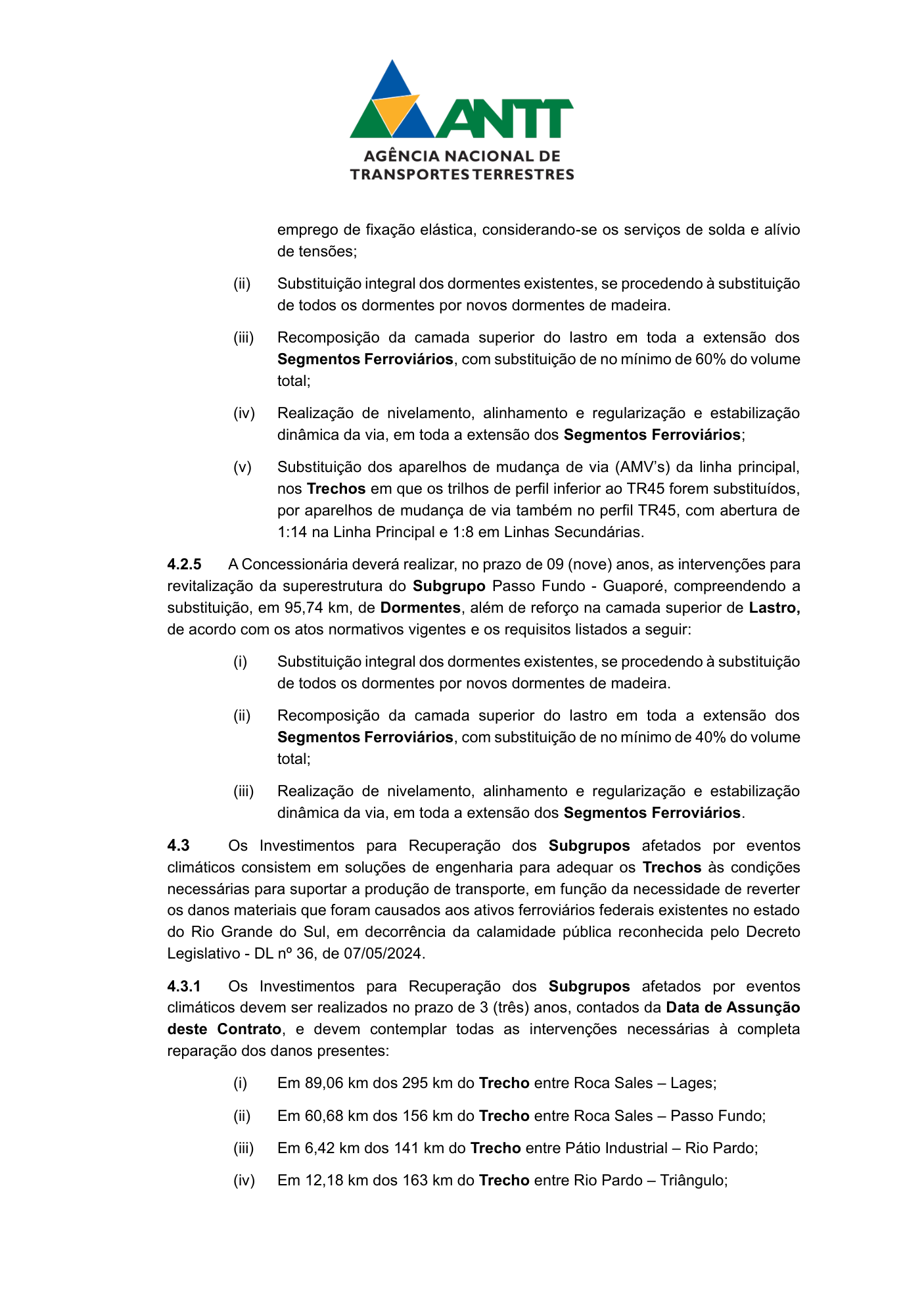
Besides the cargo, two uses already authorized by law continue without a requested clause for the entire axis. Regional passenger transport and Tourism, provided for in the Legal Framework of Railroads, have only partial requests: Northeast associations request a study, but only for the coastal EF-485, and AMURC requests shared use, but only up to São Cristóvão do Sul. The strategic reserve of use by the Union, for defense and mobilization trains, AMURC touches upon by proposing cooperation with the Army, without requesting a reserve clause. None of these uses is included in the draft as an obligation, and the consultation is the only moment when it is possible to request their inclusion.
How to contribute, step by step
Anyone can contribute, free of charge, online, without a lawyer, until 11:59 p.m. on September 30, 2026, in accordance with Article 23 of Resolution ANTT No. 6,020 of July 20, 2023.ANTT Resolution No. 6,020, of July 20, 2023. The door opensThe event at ParticipANTTAnd you log in through the gov.br account — the basic level is sufficient, and document reading does not require registration. City hall, council, or association enters through the account of the representative, with the signed institutional letter attached.
In the "Contribute" section, there are thirty topics, one per document, and contributions are most effective when targeted to the right topic. Note the names: no topic is called "Interstate Corridor," which is how technical files refer to the Mercosul Corridor; on the screen, topics in this batch are "Mercosul Corridor Obligations Notebook," "Mercosul Corridor Contract Draft," and so on. The exact device is specified, a draft is proposed, the justification is written, a PDF is attached, and the protocol proof is saved, which proves that the point was raised before the Agency's decision. Those advocating for the axis between Mafra and Lages also file the request in the three equivalent topics of the Paraná-Santa Catarina Corridor, because the connection to Curitiba crosses both batches starting from Mafra.
| Request | Where to deploy, and what it solves |
|---|---|
| Mandatory technical inspection | Obligation Book: 180-day deadline from assumption, covering the geometry of the route, superstructure, platform, drainage, bridges, viaducts, tunnels, and level crossings of 292.76 km, with a public report. |
| Recovery plan with schedule, physical goal, and value. | Obligation Book: makes the obligation enforceable ex officio, without relying on subsequent negotiation, as demonstrated by the second party in this series today. |
| Safeguard against return or deactivation. | Contract Draft: prohibits return until the study and the Agency's reasoned decision are completed, and protects stations, yards, switches, and workshops. |
| Passenger and tourism study along the axis. | Contract Draft and Obligation Book: addresses the gap identified in the Demand Study, with a deadline set in the contract. |
The Agency is obligated to analyze everything it receives and publish a report with the full reproduction of the manifestations, in accordance with Resolution No. 6,020 of 2023. There is no contribution too small to enter the process. Questions about the procedure are addressed by the Public Hearing Commission, at the following address:ap011_2026@antt.gov.br.
7. What comes next, and what remains open?
With the deadline passed, the ANTT will consolidate the comments and forward the process to the TCU: the tender is scheduled for publication in December 2026, the auction of the three lots is planned for the first quarter of 2027, and the current contract ends in February 2027. After sending it to the TCU, any changes will depend on individual negotiations, without the force of a public hearing.
This investigation does not know, until publication, if any Serraan entity is preparing a manifestation, if AMURES deliberated on the matter in a meeting, or if the City Hall of Lages was formally notified of the inquiry; none of this is stated in public documents. Unanswered remain the questions inherited from previous sections: the number of the sanctioning process and the infraction report against the concessionaire, the value and status of the fine, the reports of the scheduled inspections for 2025 on the stretch, and the date of the last commercial circulation between Mafra and Lages.
| Actor | Request | Reach in the route mapping |
|---|---|---|
| AMPLANORTE, with AMUNESC, AMVALI, and CIMU | Inclusion of EF-485 in regional passenger transport studies | Coastal axis, from São Francisco do Sul to Mafra |
| AMURC | Full maintenance of the section, asset protection, prevention of return, shared use, multimodal poles, and cooperation with the Army | From Mafra to São Cristóvão do Sul, in the Contestado region |
| AMURES and mountainous municipalities | No published contribution | Southern end of the segment, up to Lages |
| Government of Santa Catarina | Corupá Mountains, Babitonga Bay, state logistics law | Coast and north of the state |
| Curitiba City Hall and IPPUC | Curitiba Railway Ring as mandatory work | Paraná-Santa Catarina Corridor |
| MPF, Coordinated Action South Mesh | Minimum possible number of returns and reuse of infrastructure | Entire South Mesh |
Anyone who protocols a contribution about the axis between Mafra and Lages can send the protocol number through the pageSuggest a Pautaor by emailnewsroom@insubornavel.comAfter the deadline, Insubornável will publish the balance of what Catarinense Mountain Range brought to the Agency.
What the contract reserves for each section, in reais
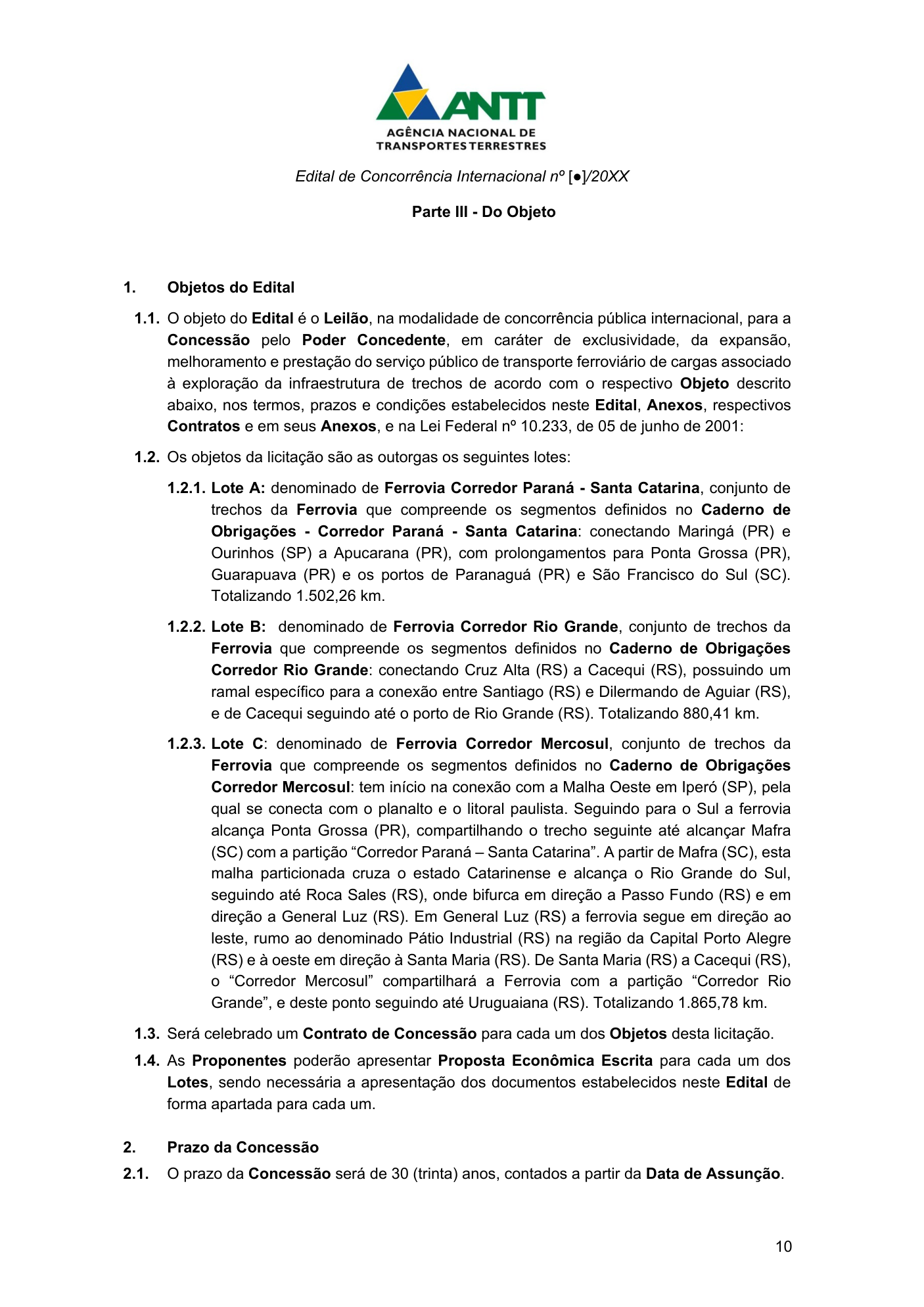
The consultation does not only decide who speaks: it decides how much each section of the track receives. The Obligations Book, which is Annex 1 of the contract, includes in Appendix A Table 3, titled "Total Cost Estimate of Determined-Term Investments", and this table lists, section by section and in reais, what the future concessionaire is obligated to do with a set date.
The care with which the modeling was put together can be measured by the first page of the very Obligations Book. Item 1.1 states that this book defines the obligations "of mandatory compliance by the Concessionaire of the 'Paraná - Santa Catarina Railway'". The phrase is correct in one of the three documents and incorrect in the other two, because the same page also opens the Interstate Corridor and the Gaucho Mesh books, which are other concessions, with a different object and contract. The three files diverge from each other in the investment tables and work deadlines, but the page that defines to whom each one applies was copied without correction: the three images on the first page have the same verification code. It's a formal defect, and it doesn't change a comma from what Table 3 determines; it's noted because the ANTT received from the TCU the recommendation to extend the contribution period precisely to perfect these documents, and because the State of Santa Catarina maintains in court that it did not have full access to the studies that support them.
On the Interstate Corridor, where the Serra line is located, the entire table fits on six lines. Four are superstructure works: Roca Sales–General Luz, for R$ 187,734,845.56; Tigre–Cacequi, for R$ 201,824,715.35; Passo Fundo–Guaporé, for R$ 149,471,473.29; and Pátio Industrial–General Luz, for R$ 77,426,712.35. The fifth includes the recovery of the sections affected by the 2024 floods and accounts for R$ 2,279,736,004.84 on its own. The sixth is for locomotives, and instead of a value, it has an asterisk: "Met through leasing, as established in the Contract". The corridor totals R$ 2,896,193,751.39, and almost four-fifths of that money goes towards rebuilding the Gaucho Mesh.
The section between Mafra and Lages does not appear on any of these lines: it doesn't show up with a lower value, a longer deadline, or under another name, and it simply is not on the table. The same goes for the 206.22 km between Lages and Feitor Faé, because the climate event recovery reaches 89.06 km of the 295 km subgroup Roca Sales–Lages, and those 89.06 km correspond to the length of the Feitor Faé–Roca Sales segment, already in Gaucho territory, with no relation to the 89 km between São Cristóvão do Sul and Lages mentioned in Section 2.
It's not a forgotten section, and that's the point: the Engineering Study for the same corridor identifies the line by code INTE_04, assigns it 292.76 km of metric gauge, and decomposes it into twelve segments measured one by one, from Mafra to Itaiópolis, 35.77 km, to Correia Pinto–Lages, 30.27 km. The same study warns, when discussing the impact of not recovering the damaged sections, that the corridor would be "virtually reduced" to three segments, and names Mafra–Lages as one of them. The same study that measured the line segment by segment, cataloged it, and recognized its importance is the one that left it out of the works plan.
Comparing it with the neighboring corridor completes the reasoning: in Table 3 of the Paraná–Santa Catarina Corridor, Mafra appears twice, and both times with money: the Engenheiro Bley–Mafra segment receives R$ 163,686,493.20, and the Mafra–São Francisco do Sul segment R$ 608,179,880.89. Mafra is served, therefore, but as a point of passage for the loads that descend to the Paranaguá and São Francisco do Sul ports. The line that leaves Mafra and climbs the serra towards Lages is the one that receives nothing.
Let's say what these works are, so as not to imagine a new railway. The book describes renovation: standardization of the track to the TR57 profile, in long-sold track with elastic fixation; complete replacement of the sleepers by new wooden sleepers; recomposition of the upper layer of the ballast, between 40% and 80% of the volume according to the section; leveling, alignment, and dynamic stabilization of the track; and replacement of the points apparatus. It's the heavy maintenance a line receives when it is intended to be used.
The size of the cake also deserves examination, as the global figure impresses at first sight but shrinks on closer inspection. The R$ 14.4 billion projected for the entire South Mesh, divided by the 4,248.45 km of the new concession, amounts to R$ 3.39 million per kilometer, or approximately US$ 659,000 at the August 2026 exchange rate. In Argentina, the renewal of 1,593 km of the Belgrano Cargas line, a narrow-gauge railway like ours, is budgeted at US$ 2.9 billion, which is US$ 1.82 million per kilometer, almost triple the amount. The World Bank, in a study on the poor railways of sub-Saharan Africa, estimates at least US$ 350,000 per kilometer, at 2008 prices, to rebuild existing lines with new materials, a value that, corrected for American inflation, is close to what ANTT projects. Brazil's plan is not generous: it remains at the bottom of what the world spends to recover old railways.
Even within the consultation, some contest this bottom limit: Davi Barreto, President of ANTF, argued in the Brasília session that the modeling understates recurring investments and does not provide for adequate rolling stock, and that the locomotive leasing adopted in the tender "does not exist in Brazil and is not a reality of the Brazilian industry." The Superintendent of Railway Projects at Infra S.A., Diógenes Alvares, responded that "it is not a deterministic study" and that there is room to reassess both the operational cost and the investment. If costs increase upon revision, the surplus of the Paraná-Santa Catarina Corridor, which is the source of the promised R$ 4.93 billion in cross-investments for the two deficit corridors, will shrink, and the segment that already entered without any funding will become the last in a shorter queue.
9. The shrunk design and the money already owned
Before the contract and before the table, the kilometer account had already changed. The concession ending in 2027 covers 7,223.4 km, as per the ANTT page on the Rumo Malha Sul contract; the one under consultation covers 4,248.45 km, summed across the three corridors, as per the College Directorate's communication of June 2, 2026. Subtracting these two official figures yields 2,974.95 km, or 41.2% of the currently granted extension, excluding the corridors going to auction—this calculation's figure, not disclosed by the Agency. The communication also does not state what will happen to this difference: it makes no mention of return, deactivation, a new tender, or any other disposition. The question is not from the Unyielding: in a circular letter of February 27, 2026, seven members of the MPF already noted that the report by the Ministry of Transport's working group suggested returning extensive segments, "based on another study by the Ministry that has not yet been made public to society."
Here, the precision that changes the reading of the Catarinense case: the 292.76 km between Mafra and Lages are not among the excluded kilometers, because the Mercosul Corridor restarts precisely in Mafra, according to the description in the same communication. The segment entered the perimeter, and that's why Table 3 from the previous section is important: for what was left out, the exit was already made in the design; for what entered without marked works, the exit will be available later, through a request for return due to idleness allowed by clause 3.2.5, as the second part of this series showed.
The money follows the same design as the route, and the communication breaks down the R$ 4.93 billion in cross-investments mentioned in the previous section as follows: the Paraná-Santa Catarina Corridor, which handles 78% of the Malha Sul's cargo, transfers R$ 1.47 billion to the Rio Grande Corridor and R$ 3.46 billion to the Mercosul Corridor, an arrangement that, in the document's words, ensures the viability of the ensemble "without relying on direct contributions from the Treasury as the primary source." How much the corridor receiving the largest transfer costs is a point where two documents from the same Agency diverge: the official project page attributes R$ 4.5 billion to it, while the communication speaks of R$ 4.8 billion. Using either figure, and deducting the approximately R$ 3 billion already allocated to the reconstruction in Rio Grande, there are between R$ 1.5 billion and R$ 1.8 billion left for the entire remainder of the 1,865.78 km of the corridor, which starts in Iperó, São Paulo, and crosses Paraná and Santa Catarina before reaching Rio Grande do Sul. The subtraction is from this calculation; the divergence between the figures is from the official documents.
There is a second, less cited but more eloquent number: the table below shows CAPEX (the investment money, what is spent once to build, rehabilitate the track, and buy equipment) and OPEX (the current expense of operating and maintaining the railway, year after year), and it is the OPEX, projected over thirty years of concession, that matters here. Dividing each corridor's figure by its length and by thirty years, the annual expense per kilometer is R$ 605,754 in Paraná-Santa Catarina, R$ 238,555 in Rio Grande, and R$ 87,542 in Mercosul: 6.9 times less, per kilometer, in the corridor where Lages' line is, compared to the structuring corridor. The division is from this calculation based on the published values. Low operational expense per kilometer is, as a rule, a projection of a sparsely used train; however, the Unyielding did not have access to the calculation memory, and the explanation may lie in the economic-financial model submitted to the consultation, which has not yet been read by this calculation.
| Corredor - Corridor | Extensão - Extension | Carga - Load | CAPEX - Capital Expenditure | OPEX - Operational Expenditure | OPEX por km ao ano - OPEX per km per year |
|---|---|---|---|---|---|
| Paraná–Santa Catarina - Paraná-Santa Catarina | 1.502,26 km - 1,502.26 km | 78% | R$ 6.9 billion | R$ 27.3 billion | R$ 605,754 |
| Rio Grande | 880.3 km | 16,6% | R$ 3.0 billion | R$ 6.3 billion | R$ 238,555 |
| Mercosul (Inter-state) | 1,865.78 km | undisclosed | R$ 4.5 bi | R$ 4.9 bi | R$ 87,542 |
The final piece of this series arrives at a point where the second part reached through another route: work not foreseen in the Obligations Book, of medium or large volume, depends on a common agreement with the concessionaire. Recollecting almost three hundred kilometers in operation would be work to negotiate within the corridor whose investment budget is already committed, in most part, to another state. The project page discloses an internal return rate of 14.08%, without detailing the assumptions or breaking it down by corridor. The Catarinense section does not appear in this calculation with a specific name, for the same reason it does not appear in the draft: in both documents, it falls within the scope of the concession, without any line naming it.
10. To explore: the sources, with notes
10.1 The previous parts of this series
- The Lages Railway is on the map of the new concession, but not in the works plan. Part 1 of the series about the South Main TrunkIt shows that the section is part of the concession object and does not appear in the mandatory investment plan, and registers AMURC and AMPLANORTE as the two institutional actors who defend the section within the ANTT process.
- The contract draft obliges the care of the track between Mafra and Lages, but does not set a deadline for the resumption of trains. Part 2 of the seriesReads the draft clause by clause: conservation duty without operation deadline, return for lack of traffic, compensation convertible into work on another section, and absence of the words "Army", "military" and "national defense" in the central 617 pages of the consultation.
10.2 The public consultation documents
- Public Hearing No. 11/2026 — ANTT, with all annexes and contribution formDeadline until September 30, 2026, 11:59 PM.Primary source of this investigation: the 180 published contributions were read one by one on the "Published Contributions" tab on August 24, 2026, and the authorship table by actor was constructed from the text and annexes of each piece, as the system does not have an author field.
- Contribution from AMURC, on the Economic-Financial Model of the Mercosul Corridor.Ten pages dedicated to the section between Mafra and Lages, with seven numbered requests, diagnosis of the five municipalities represented, based on the reduction of regional inequalities, and proposal for cooperation with the Army Engineering by Decentralized Execution Term.
- Circular Letter No. 7/2026, from the associations AMUNESC, AMPLANORTE, AMVALI and the CIMU Consortium.Speaks for 26 municipalities in Santa Catarina and approximately 1.6 million inhabitants; requests the inclusion of the EF-485 section, between São Francisco do Sul and Mafra, in the regional passenger transport studies.
- ANTT extends until September 30 the deadline for contributions on the concession of the South MeshOfficial notice of August 14, 2026.Formalizes the second extension of the deadline, approved by the College Board during a Public Deliberative Meeting on the same date; the first one extended the deadline from August 10 to 25.
- ANTT Resolution No. 6,020, of July 20, 2023..Regulates the Social Participation and Control Process of the Agency; Article 23 is the basis for written contributions, and the norm obliges the ANTT to publish a report with the full reproduction of the received manifestations.
- ANTT Resolution No. 6,058, of December 19, 2024..Defines idle segments due to the absence of commercial traffic in the last two years and regulates the call for another operator; it is the norm that completes the circle described in Section 4.
- ANTT closes the cycle of the Public Hearing on the Concession of the South Mesh with wide social participation..Source of the numbers from the four in-person sessions: 665 participants and 249 registered for oral manifestation, in Brasília, Curitiba, Porto Alegre, and Florianópolis, between July 16 and 31, 2026.
- Annex 1 — Interstate Corridor Obligations BookletPublic Hearing No. 11/2026 of ANTT.Presents Table 3, with the total cost estimate of the defined-term investments for the corridor; this is the table where the section between Mafra and Lages does not appear.
- Annex 1 — Railway Paraná-Santa Catarina Obligations BookletPublic Hearing No. 11/2026 of ANTT.Table 3 of the neighboring corridor, with R$ 163,686,493.20 in the Engenheiro Bley-Mafra segment and R$ 608,179,880.89 in the Mafra-São Francisco do Sul segment.
- Product 3.2 — Interstate Corridor: Engineering Dimensions, Revision 2Nova Malha Sul Consortium for ANTT.Identified as INTE_04, with 292.76 km in metric gauge, and decomposed into twelve segments measured between patios.
- Off Track: Sub-Saharan African RailwaysBy Richard Bullock. World Bank, November 2009.Source for the international parameter of cost per kilometer for the reconstruction of existing line in metric gauge and low-speed railway.
- South Mesh: audience exposes risk of higher costs and charging for works. iNFRA Agency, July 17, 2026.Coverage of the Brasília session of Public Hearing No. 11/2026; source of the statements by Davi Barreto and Diógenes Alvares cited in Section 8.
- South Mesh - TenderOfficial page of the project, ANTT.Source of CAPEX and OPEX by corridor and the internal return rate of 14.08% cited in Section 9.
- ANTT opens Public Hearing for the new concession of the South Mesh and advances in the structuring of three railway corridors in the South of the country.. Board of Directors' Communication, June 2, 2026.Source of the extension of 4,248.45 km, the participation of each corridor in the load, the transfers of R$ 1.47 billion and R$ 3.46 billion, and the allocation of approximately R$ 3 billion to reconstruction in Rio Grande do Sul.
- Rumo Malha Sul S.A.. ANTT's current concession page.Source of the 7,223.4 km concession that ends, the start of operation on March 1, 1997, and the thirty-year term.
10.3 The indicators of Serra Catarinense
- Lages (SC): panorama — Brazilian Institute of Geography and Statistics.Source of the per capita gross domestic product of R$ 50,561.28 in 2023 and the Municipal Human Development Index of 0.770.
- Sustainable Municipal Development Indicator System — Catarinense Federation of Municipalities.Source of the performance ranking of Lages and other municipalities in the plateau in the state ranking.
- In the Serra de SC, 13,000 families live in poverty and extreme poverty, says research — Cruzeiro do Vale Journal.Survey attributed to AMURES, cited in Section 4 of this report.
10.4 The entities that defend the segment
- AMURC — Association of Municipalities of the Contestado Region, headquartered in Curitibanos.Includes Curitibanos, Santa Cecília, Ponte Alta do Norte, São Cristóvão do Sul, and Frei Rogério; three of these municipalities are crossed by the route between Mafra and Lages.
- AMPLANORTE — Association of Municipalities of the North Catarinense Plateau, headquartered in Mafra.Signs the joint petition from the four associations of the Northeast of Santa Catarina and is responsible for the starting point of the line.
- AMURES — Association of Municipalities of the Serrana Region, headquartered in Lages.Includes 18 municipalities of the southern plateau and is responsible for the southern end of the section between Mafra and Lages; not included in the published contributions as of August 24, 2026.
- Railway Legal Framework — Federal Law No. 14,273, of December 23, 2021.Legal basis for regional passenger transport, railway tourism, and the strategic use of the Union invoked in this investigation.
Produced with Claude Fable 5 (Anthropic, AI), directed and responsible by Benito Juarez.